
(No caption)
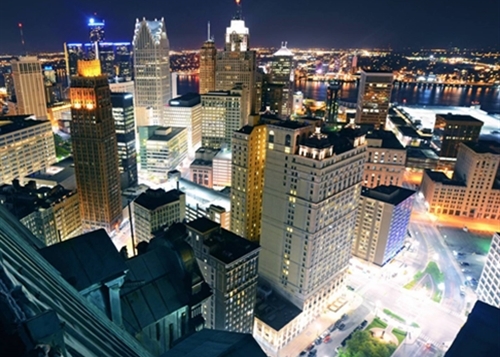
Looking good, and healthier, too. (File photo)
Anniversary journalism has its critics, but the largest municipal bankruptcy in the country wasn't a one-and-done story, and Wednesday's five-year look-backs at how Detroit has fared since -- and may well fare in the future -- are more than justified.
While undeniably on firmer financial footing, and with a far brighter future as a result, bankruptcy reorganization only solved some of the city's problems, and many others still remain.
So, a quick rundown of stories worth a look:
In the Detroit News, columnist Daniel Howes takes an optimist's outlook:
Five years to the day after the city’s lawyers filed for Chapter 9 bankruptcy, Detroit’s reinvention is tracing a decidedly upward arc. It’s produced four balanced budgets, received three credit upgrades, improved delivery of basic city services, imposed fiscal discipline and attracted billions in private-sector investment. ...A new normal is setting in: business that for decades decamped downtown for the suburbs is returning, reversing a mostly one-way capital flow; investment in downtown now is measured in billions; a new sense of civic pride and can-do spirit has emerged, with business and political leaders now angling to push the reinvention deeper into the city's neighborhoods.
In the Freep, John Gallagher is similarly bullish, but credits luck as well the financial plan:
Many other factors, from an expanding national economy to the new appeal of downtown living, have contributed to Detroit's partial recovery. Indeed, without the confluence of several factors, the bankruptcy by itself could have been nowhere near as a successful as it has been.
Susan Tompor at the Freep looks at how some city pensioners are doing, having taken a haircut in both pension payouts and affiliated benefits:
In the end, the bankruptcy proceedings eliminated $7.8 billion in payments to retired workers and the city got off the hook for $4.3 billion in unfunded health-care obligations and future costs.
It could have been far worse. At one point during the bankruptcy journey, the city's general retirees were threatened with the possibility of seeing their pension checks slashed by up to 34 percent and police and fire retirees were looking at cuts of up to 10 percent.
WDET covered the story aggressively, and "Detroit Today" morning host Stephen Henderson had a few of the journalists who covered it most closely to talk about the story and how it played out. Listen here. There's also a feature documentary in the works about it, and you can watch a teaser trailer here.
Finally, Benzinga, a financial-news site, covered a panel discussion Wednesday at the Gem Theater, with representatives from various affected constituencies, including the city, pensioners and lawyers who represented the parties:
George Orzech, a retired Detroit Fire Department battalion chief who serves on the city’s Police and Fire Retirement System board, was in the audience for Wednesday’s discussion at the Gem Theatre.
When asked if he felt the city’s bankruptcy — which ended after 17 months on Dec. 10, 2014 — was an equitable settlement, Orzech shook his head.
“How do you equate art with people’s health and people’s lives?” Orzech said, referring to the city-owned Detroit Institute of Arts pieces that were at stake.
The last word goes to Sheila Cockrel, former city council member and longtime advocate for the city, who was a panelist at the Gem:
“The renaissance story is fabulous. I think Ford’s move here is an iconic move for the city and for them. There’s a chance here to be able to create a new paradigm for bringing back a city has been in decline,” Cockrel said.
“It’s gonna require dealing with the reality that there are two Detroits. We can paper over it if we want, but there are two Detroits.”