
The Tigers in the 1968 World Series at home.
The writer, a former Detroit Free Press reporter, is a Deadline Detroit contributor.
By Michael Betzold
This summer, both the DIA and the Detroit Historical Museum are featuring exhibits about the 1968 Tigers. Nostalgia is running rampant, and why not? For me, that summer was a crazy trip around the bases.
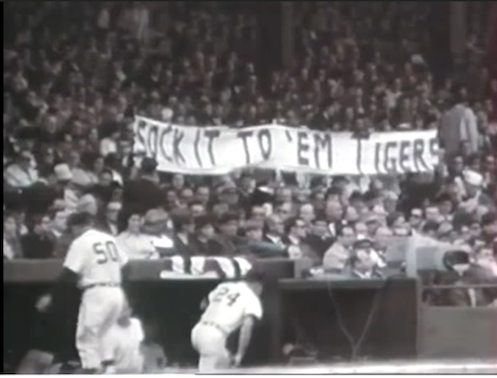
The Tigers in the 1968 World Series at Michigan and Trumbull.
In early June, the night before I graduated from Sacred Heart Seminary High School, some of us snuck out of our dormitory to stage an all-night sleep-out on the grounds. It was a final act of defiance after four years of devising inventive ways to break the institution’s many petty and arbitrary rules. (The seminary didn’t succeed in training me for the priesthood, but it sure helped me learn ways to defy authority—a skill that would be handy in the years to come.)
Around midnight, we heard on our transistor radio that Robert Kennedy had won the California Democratic primary—and then that he was shot. Just a few weeks earlier, the rector had let us outside to watch RFK’s motorcade as it inched down Clairmount to Linwood.
It was an unforgettable sight—seas of black hands reaching out to touch him as he sat on the trunk of a convertible. This occurred just weeks after Martin Luther King Jr. was assassinated and less than a year after Detroit went up in flames during the rebellion that began less than a mile from the seminary.
Only a few members of our faculty grasped the reasons for the upheavals all around us. Among them was Father Bill Cunningham, my tenth- and twelfth-grade English teacher. Cunningham was our own version of a Kennedy—handsome, charismatic, outspoken. He rode a motorcycle. He started a film series at the seminary, showing scandalous foreign fare like Bergman and Fellini. By the summer of 1968, he was already recruiting some of us to be among the first volunteers for his new Focus: HOPE organization.
Everything seemed in flux in those days, even inside the seminary. Our freshman class started with 212. Only 88 graduated, and just a handful became priests. Between our sophomore and junior years, in response to Vatican II reforms, the rector tossed out the manual that forbade us from dating or partying. By the time we graduated, some in our class already had steady girlfriends.
Many of my classmates in those increasingly serious romances still sincerely wanted to be priests and believed the church would soon end the celibacy rule for priests. They were ultimately forced to choose between their sweethearts and the priesthood. The Church lost, unanimously.
It had lost me by my sophomore year. I told my parish priest in St. Clair Shores I was going to confession at the seminary, where I boarded during the week. I told the priests at the seminary I was going to confession at my parish on weekends at home. I never went to confession in either place—and no one was the wiser. By church rules I was no longer even a Catholic during my last two years at the sem.
My faith succumbed merely to doubt. Others had their piety defiled violently. Unbeknownst to me, some of us were being groomed as prey. One of my best friends, decades later, told me about his brutal experience. And he was far from the only victim who was silenced and intimidated. There were priests and students who knew the perpetrators but stayed quiet out of fear of being punished or blackmailed or shamed. One of the most courageous and outspoken priests anywhere, Bishop Thomas Gumbleton, was abused by a faculty priest at Sacred Heart in 1945 but didn’t disclose it until more than sixty years later—and lost his parish when he finally did.
Life Beyond 12th Grade
What is more exhilarating than the summer you graduate from high school? I happily wallowed in a bad case of unrequited love.
“Dates” with Debbie started in our hometown of St. Clair Shores and usually consisted of cruises down Lakeshore Drive and Jefferson ending at the Big Boy across from Belle Isle. I adored her, but had no clue how to get to first base.
I did know how to get to Michigan and Trumbull, though. Ever since my older sister Peggy started taking me to Ladies’ Day games in the 1950s, Tiger Stadium had been my window to the world beyond my parochial suburb—men smoking cigars, talking in strange accents, yelling inscrutable oaths, peeing into the troughs of gang urinals.
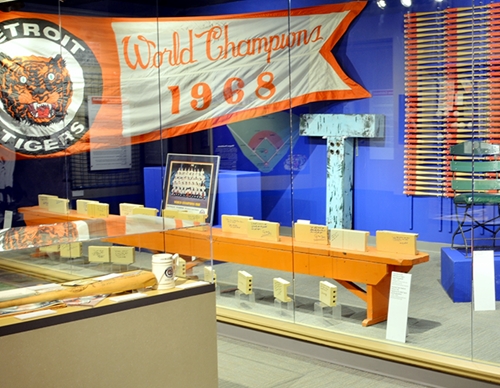
An exhbit titled "The Year of the Tiger: 1968" is at the Detroit Historical Museum through Oct. 7. (Detroit Historical Society photo)
The 1968 team started 9-1 and never looked back. They were a wacky, seemingly mismatched group—the Pepsi-drinking, organ-playing Denny McLain. The future donut impresario Mickey Lolich. The taciturn veteran star Al Kaline. The great all-around athlete from Northwestern High, Willie Horton. The ex-con, Gates Brown. The Texan good old boy Norm Cash, chaw of tobacco in his bulging cheek.
The broken, stricken city rallied around this lovable bunch of misfits. Orange-and-white paws hung on car radio antennas. Signs on businesses proclaimed “Sock it to ‘em Tigers.” Ernie Harwell’s radio voice could be heard everywhere—at the beach, at picnics, from cars cruising down Woodward.
Though the myth is that the ’68 Tigers united Detroit, that was true only in the superficial sense that rooting for a sports team provides an artificial collective bond that papers over reality. The Tigers’ triumph had no effect on the ongoing mass exodus of white homeowners from the city to the suburbs or on the redlining in the housing market that codified racial division. The team was merely a diversion from the harsh divide that deepened after the 1967 upheaval.
'If You Weren't So Ugly'
It’s true, though, that the ballclub did seem to embody a sort of underdog resilience. It seemed like every day some new hero delivered a game-winning hit or homer. The one I remember best was the most improbable of all. Tommy Matchick, a light-hitting utility man, came up in the bottom of the ninth and somehow hit it out of the park. Dick McAuliffe reportedly told Matchick after he crossed home plate: “If you weren’t so ugly, I’d kiss you.”
Deep in the lower deck down the first-base line, Debbie was so excited that she threw her arms around my neck and kissed me. It was the most physical contact we ever had.
Even Michigan and Trumbull was no haven from the intense political turmoil of that summer. One night, Eugene McCarthy held a huge rally at Tiger Stadium. I went with some friends. My politics were as confused as my love life; my weekly consumption of the conservative US News & World Report clashed with my love for RFK and the civil rights movement. I remember sitting in silence as everyone around me stood and cheered McCarthy’s denunciations of the Vietnam War. That is my last and very indelible memory of ever being conflicted about the war.
As summer faded, the fun at Tiger Stadium became comic high drama. I witnessed it all.
I was in the bleachers when McLain deliberately served up a fat one so Mickey Mantle could hit a milestone home run—though I didn’t understand at what was happening. Soon after that, I saw McLain’s 30th win.
Ticket booth at Tiger Stadium
And when on that glorious September day when the Tigers clinched the pennant and Ernie intoned “Let’s listen to the bedlam at Tiger Stadium,” I was deep inside the bedlam.
For the World Series, fans sent in ticket requests in a mail-order lottery. I got tickets to Game Five on Monday afternoon—certainly a good enough reason for me to skip a few college classes for the first time, even with the Tigers down three games to one and facing elimination
Most of the seats at Tiger Stadium were great. But in the lower deck in left field, there was one row of posts at the outfield fence and another row much farther back. My seats were smack dab behind a post in that second row. I didn't really care about that; the Tigers were in the World Series, and Debbie was sitting beside me.
Horton's Deadly Throw
When Willie Horton charged a line-drive single in the fifth inning and unleashed a deadly throw home, Bill Freehan blocked home plate as Lou Brock arrogantly disdained a slide and was tagged out. It’s the most iconic play in Tigers history, and it turned the series around. I saw little of it around that post—but I was there. I drove Debbie home—it was our last date we’d ever have.
With hope for victory still alive, I went up to East Lansing while my heroes flew to St. Louis.
Back at MSU, I watched in the student lounge at Case Hall as the Tigers won Games Six and Seven. But it was not the same: I celebrated alone in the midst of studied indifference to something as bourgeois as sports. No parades, no bonfires. Classes as usual. Stunned, I felt lost in my new milieu. I couldn’t even get any demerits for skipping Mass!
But my excellent seminary training in anti-authoritarianism would pay off. Soon I was challenging teachers and marching against the war. My distance from Sacred Heart, Tiger Stadium, and Debbie began to feel a lot longer than the ninety miles on the map. Like many others, I had traveled a long way over that summer of 1968.


