
Mayor Duggan, Chris Ilitch, Tom Gores at Pistons press conference
The recent announcement that the Detroit Pistons are returning to the city after 38 years is greeted by many, including Mayor Mike Duggan, with great fanfare.
But not all are doing hand stands and jumping with jubilation.
Bill Johnson, a former editorial writer for The Detroit News (1987-2002), questions the financial feasibility of doing this in a broke city, in an opinion piece at his former home headlined "Pistons move is Robin Hood in Reverse." He sees it as the rich robbing the poor.
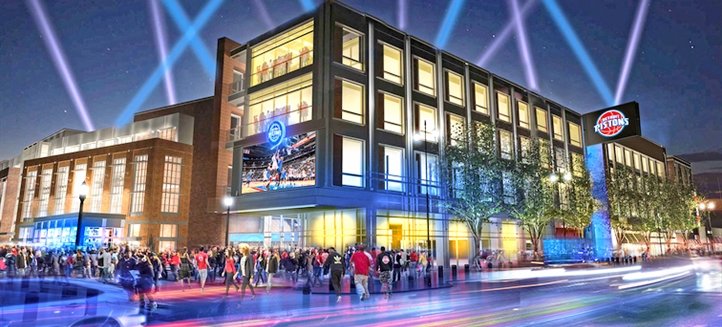
Architectural rendering of Little Caesar's Arena
Johnson, a Detroit communications consultant. writes:
Detroit seems to be ready to facilitate the Pistons return to Detroit at all costs.
But can Mayor Mike Duggan justify an investment of additional public tax dollars in a struggling economy and the reality that Detroit is broke—financially, socially and economically?
The homecoming is expected to cost an additional $34.5 million in public funding that will come from refinancing and extending $250 million in public bonds previously issued to help pay for the Little Caesars Arena construction. The bonds won’t require tapping the general fund. Rather they will be retired using property tax collections captured for “economic development” by the Downtown Development Authority (DDA). However, the city can’t afford further cash diversions from the real problems that retard real growth.
Shootings, homicides, carjacking, arson, population loss, just to name a few problems, keep Detroit perched at the top of national statistics. Police ranks could use a $35 million shot in the arm.
Detroit is also a perennial national leader in high unemployment and low labor participation rates. It is the poorest major city in America, with about 40 percent of residents living at or below poverty line. With a median income is slightly above $25,000 a year, few Detroiters earn enough to purchase even the cheap Pistons’ game seats.
Johnson is skeptical the move will have as great a financial benefit to the city as is being touted.
And he concludes:
The last thing Detroit needs is another big, expensive, low-community-benefit project that primarily serves to subsidize rich team owners at the expense of other private businesses and the working poor.


