
(No caption)
The writer was a 52nd District Court judge in Novi and assistant state attorney general. He's chief financial officer of the Justice Speakers Institute and a Deadline Detroit contributor.

By Brian MacKenzie
The number of people claiming that the American governmental system is broken and that it is impossible to fix is growing. Anti-democratic rhetoric is now common.
On Twitter, Facebook and other social media, people routinely claim that our founders created a republic, not a democracy, while others express support for rolling back democratic election reforms. The growing support for an authoritarian type of government is reflected in a recent survey that reported the number of Americans who believe that it would be better to have a “strong leader” who does not have to bother with “elections” has risen to 32 percent.
I bring this all up because I want to talk about Flint. But before I do, let me go on.
The idea that a third of Americans support an authoritarian government in place of our democratic system is shocking and not simply because the United States is the oldest modern democracy. What is astounding is the belief held by a substantial number of Americans that any authoritarian government, in the long run, is better or more efficient for its citizens than one that is democratic.
Authoritarian systems routinely fail their citizens. History is replete with examples like Nazi Germany and the Soviet Union, but that failure can also be observed in the City of Flint.
In 2011, Gov. Rick Snyder signed a bill eliminating revenue sharing for local communities. The immediate result was that a number of Michigan’s poorer cities could not balance their budgets.
One of these cities was Flint which immediately projected a $25 million deficit. That same year the governor signed a law that gave him broad powers to appoint an emergency manager for these poorer communities including Flint. While not often characterized this way, the idea behind the law was that an emergency manager would be a “strong leader” freed from democratic restraint, managing a city like a business, and in that way, fixing its fiscal problems.
As we all know, it did not work out that way.
In June 2012 Flint’s first emergency manager, Mike Brown, pushed to blend Flint River water with Detroit Water and Sewage Department (DWSD) water to save money. Fortunately, that request was rejected.
In November 2012 Brown’s replacement, Ed Kurtz asked state Treasurer Andy Dillon to switch to the Karegnondi Water Authority (KWA) due to rising costs of Detroit water. In April 2013, Dillon authorized it. On May 1, 2013, Kurtz announced that Flint water would be provide by the KWA. Neither the citizens of Flint nor their elected representatives had any real say in this decision.
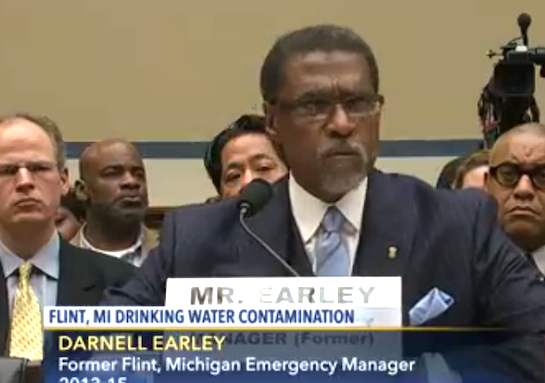
Darnell Earley
The Darnell Earley Era
Darnell Earley, Kurtz’s replacement as emergency manage, on March 7, 2014, sent a letter to the DWSD stating Flint would switch to the Flint River as the primary source of water beginning in April 2014.
Lead from aging water lines started appearing in Flint’s water supply shortly thereafter.
In children, lead causes impaired cognition, behavioral disorders, hearing problems and delayed puberty. It is associated with reduced fetal growth in pregnant women. In adults, lead consumption can affect the heart, kidneys and nerves. There is no treatment for the adverse health effects of lead; conditions are permanent.
Complaints from Flint residents started almost immediately, but Earley, who had no elected responsibility to those citizens, could, and did ignore them.
He also ignored the protests that started in January 2015 outside the Flint City Hall. He ignored the residents who turned out at a city forum, many complaining of rashes on their children. He would go on ignoring them until he left that year. It was his job to make the budget balance, not to represent or tend to the welfare of the people of Flint.
So what finally forced a change in Flint’s water? Democracy.
Those voices who were being ignored in Flint started to be heard in Lansing. The democratic pressure reached Gov. Snyder’s Chief of Staff Dennis Muchmore who wrote:
“After all, if GM refuses to use the water in their plant and our own agencies are warning people not to drink it… we look pretty stupid hiding behind some financial statement.”


