

(No caption)
Former major leaguer Doug Glanville was speechless while watching Miguel Cabrera at Comerica Park in late September -- not a good thing for an ESPN play-by-play announcer.
"Twice in my five innings of calling my first game . . . I found myself reduced to silence," he writes Saturday in The New York Times. He's an on-air analyst for the cable sports network who pinch-hit "because Jon Sciambi, our play-by-play voice, had been taken down by strep."
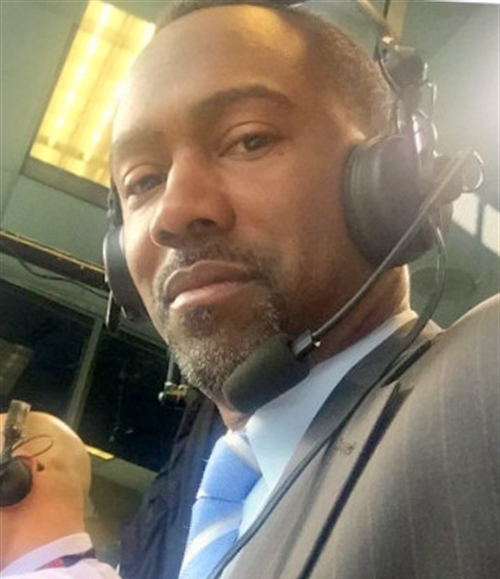
Doug Glanville at Comerica Park: "When he smacks the ball, it defies expectations." (ESPN photo)
It was a humbling baptism, says the 46-year-old retired center fielder who played from 1996-2004 for the Philadelphia Phillies, Chicago Cubs and Texas Rangers.
Cabrera's skill leaves him wordless, the ex-ballplayer says:
Cabrera is one of the greatest hitters ever. In conversation, I can easily describe why.
He has exceptional balance, he keeps his head frozen for a laser-efficient line of sight, his base that anchors him into the ground is rock strong, and he has an almost innate ability to trust his hands for so long that he hits the baseball practically out of the catcher’s mitt. He uses that bonus time to direct his hits as if he were the best tennis player on earth, deceiving the pitcher and the defense until the ball’s last breath through the strike zone.
Coupled with Cabrera’s hitting prowess is what he looks like in real time: When he smacks the ball, it defies expectations because the ease with which he swings does not align with the sizzling speed and distance it travels after he makes contact.
It carries, it rides an invisible jet stream, top flight created by top-gun hitter, creating anomalous trajectories that benefit him. . . .
Cabrera represents what I found to be the toughest challenge of calling play-by-play: You must find a way, noncommittal yet with confidence and certainty, to involve and even excite an audience about what is starting to happen before the play actually resolves.
The athlete-turned-announcer describes how Miggy left him tongue-tied during a game in which Detroit beat the Cleveland Indians by 6-3:
A shot off the bat of Cabrera that looked like it was going to hit the second baseman instead hit the wall in right-centerfield.
Then, a couple of innings later, to make a mockery of my debut, Cabrera hit another one that rocketed over the head of the right fielder, who turned around and got to watch the ball sail into the stands. For me, it was hard to make an exciting home run call when you thought the ball was going to hit the right fielder in the back.
If I’d been playing my old position, center field, I might have known at the point of contact that it was going out, but from the booth things weren’t so clear to me.


