
Mike Duggan "never would have disclosed a source," his spokesman says.
Brimming with the requisite optimism and enthusiasm, Detroit Mayor Mike Duggan Wednesday night at his State of the City address rattled off an impressive list of new major developments involving Black business people, a narrative he suggested is not being told.
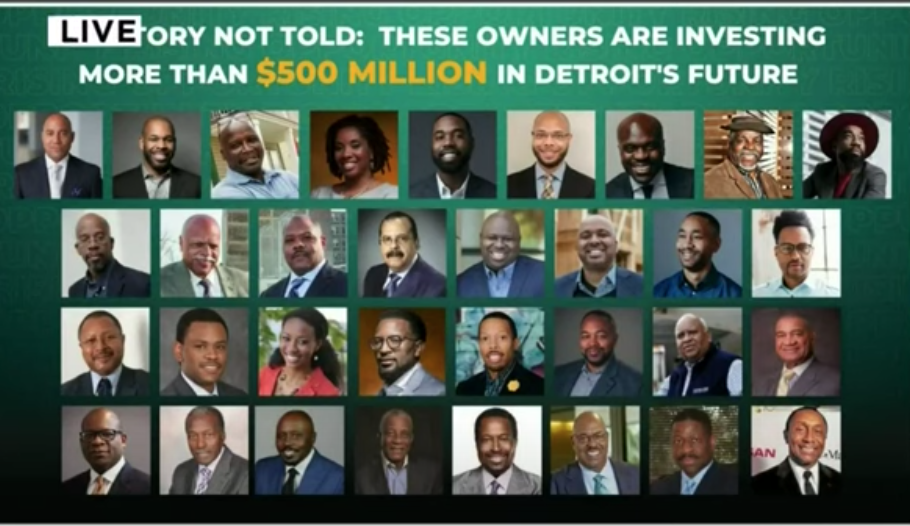
Duggan displayed photos of Black business people developing the city.
"Black developers with Black ownership are rebuilding this city. And yet, to read the stories, we are not celebrating the accomplishment."
In his ninth State of the City, Duggan spoke at the General Motors Co.'s Factory Zero Detroit-Hamtramck Assembly Center, and also hailed developments by billionaire Dan Gilbert and the Ilitch family, while praising Detroit Police Chief James White. The speech was streamed virtually and televised without the usual pre-pandemic live audience of supporters, religious leaders and politicians.
He said the Police Chief James White helped lower homicides and shootings after he took over from James Craig last September by changing stragtegy and coordinating with other law enforcement agencies. It was a slight to Craig, who resigned last June to run as a Republican for governor.
On the building front, Duggan pointed to the $135-million development by Black businessmen Greg Jackson and Richard Hosey of the Fisher Body Plant for housing and retail, Gilbert's massive Hudson's building project, the Ilitch group's resurrection of the Eddystone Hotel, Ford's development of the train station, the development of the historic Lee Plaza into a $60-million senior housing project, the overhaul of the vacant American Motors headquarters into an industrial space and the building of the Amazon distribution center at the State Fair Grounds.
He rattled off so many projects by Black and white developers that he sounded like an auctioneer.
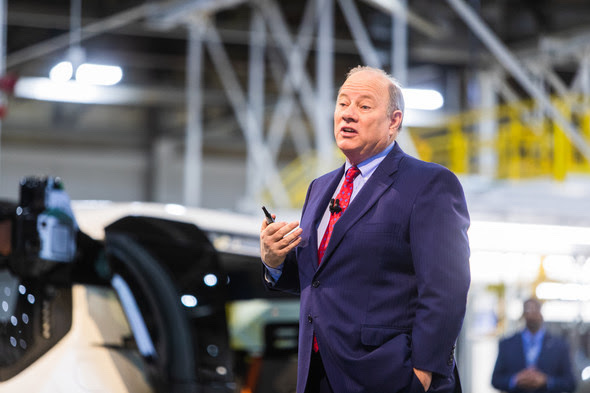
Mayor Duggan on Wednesday night (Photo: City of Detroit)
He also talked about the sprawling Packard Plant and criticized owner Fernando Palazuelo, without naming him, saying he's failed to make good on developing more than 3 million square feet of property on the east side.
"We are suing [him] because he hasn't done a darn thing to deal with the blight in the eight years that he's owned it."
He said a civil trial is scheduled for this week, with the aim of removing "the owner that's inflicted this blight on us for the last eight years and allow us to move forward."
Fernando Palazuelo (Photo from Packard Plant project)
The city, which is responsible for part of the property, has demolished 100,000 square feet since 2017 and plans to let the facade facing East Grand Boulevard be used for new development.
Duggan said Detroit is finally emerging from the Covid pandemic as numbers rapidly drop, and is ready to treat the daunting virus as an endemic, something residents will be able to live with, just like the flu. But he said the city will be prepared for any new strain and "instantly be back in action with testing with vaccines at our central our facilities."
He hailed the city's efforts to remove blight, and talked about the continued move to beautify a city that had been trashed on the national stage for too long.
That dire image of the city, he explained, was a major reason for him leaving the Detroit Medical Center to run for mayor in 2013.
"In 2012 I was in Washington, D.C. when I was working at the Detroit Medical Center at a conference and somebody said to me, 'we got a museum here with the Detroit exhibit, you gotta go over and see this,' and I said 'that's great, what is it, the history of the automobile industry being featured in these things?"
He said it actually was ruin porn from Detroit. "I couldn't believe it. I said 'who's low enough that you would go to a museum and look at pictures of another city's misery?'
He said he learned there were ruin porn exhibits of Detrot in London, Paris, Zurich, Brussels and Monaco.
"It made me extremely angry as somebody who was born here, raised here, worked here my whole life. It really was a major factor in me deciding to leave a job I loved. ... It was just getting embarrassing. This is a great city and I wanted it to be seen as a great city."
The full speech:


