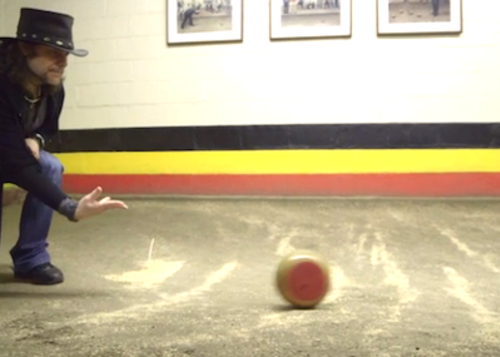
ESPN Magazine takes a close look at featherbowling at the Cadieux Cafe on Detroit's east side, a sport, a pastime it describes as the "magical, mystical sport on earth."
The Cadieux is known for its buckets of steamed mussels, and as a venue for some pretty cool music. But it's the featherbowling that really sets it apart. (Watch a video.)
Chris Koentges writes:
Featherbowling was born from that medieval family of games that endure in no small part because they can be played with a beverage in the shooter's free hand. It's Belgian shuffleboard. It's horseshoes with a pigeon feather target. It's bocce, except you roll discs that have been slightly weighted to rotate unevenly across the earth, exposing the shooter's secret divine grace.
He goes on to write about a premiere featherbowler, Mark Tirikian:
Tirikian grew up in the neighborhood. He left for college, then to play professional soccer in France. Then, when everyone he grew up with was fleeing Detroit, he moved back and dedicated himself to featherbowling. He won his first grand championship in 1998. His dad was killed less than a year later, just outside the Cadieux. Every Thursday he has to walk by where it happened. Nobody questions the blood Tirikian has in this place.
Koentges also writes about artist Jerry Lemenu, who over the years, has done sketches for WDIV in federal court for high-profile trials.
The artist, Jerry Lemenu, discovered the Cadieux 37 years earlier, mourning his mother's death. He felt then as if he'd entered some surreal dream that connected the Old World to the New. If you've ever read a major daily newspaper or watched network news, you've seen Lemenu's work. He drew Pete Rose on trial. Manuel Noriega. John DeLorean. Medgar Evers' unrepentant killer, Byron De La Beckwith. Hence the urgency of the lines. In 1981, a producer for Channel 4 in Detroit was so taken with what Lemenu could see in the courtroom that he assigned him to draw the Thomas Hearns-Sugar Ray Leonard fight at Caesars Palace. Before it happened. The station gave him a box of videotapes and a computer prediction and instructions to draw every round. And for 14 rounds, one of the greatest welterweight fights in history went exactly as Lemenu had drawn it. Hearns took the early rounds, Leonard rallied in the middle. In Lemenu's sketches, Hearns comes on strong at the end but it's not enough. "I would have been right on the money except for Hearns getting knocked out in the 14th," he says.
Lemenu has won the grand championship twice -- once on the last night of the season. He also once lost it on the final night. "Everybody is a great winner," he says. "But when you can lose graciously and tip your cap like Valere Spetebroot, who would take his handkerchief out, put it down, get down on one knee and kiss the hand of the person who beat him. When you can do that kind of thing, then you get it."
Lemenu was so moved to capture Spetebroot's era, before it disappeared, he began making sketches. He read the faces of these old Belgians like the geology of the Cadieux's trenches. He did one for each new champion. At the same time, he dug back into the roots of the game, creating portraits of those who had won before he arrived at the Cadieux. Sometimes he'd have to work off photographs. "For the time I'm drawing that person, it's like they're alive again and I'm paying them another visit. That's the only way I can do it that makes any sense to me," he says. Most artists who blow through Detroit end up spitting out the same kind of drive-by ruin porn. But those who live in the city, like Lemenu, have a subtly optimistic way of looking at it. (It's why, in the end, he couldn't see the kid from Detroit getting knocked out by Leonard.) Lemenu watched Gosskie closely during that improbable championship season. "He'd throw these balls that would whack off one ball and whack off another and fall just right. Steve Gosskie was as unlikely as anybody," Lemenu says. "Maybe more than anybody, he needed it"


