
(No caption)
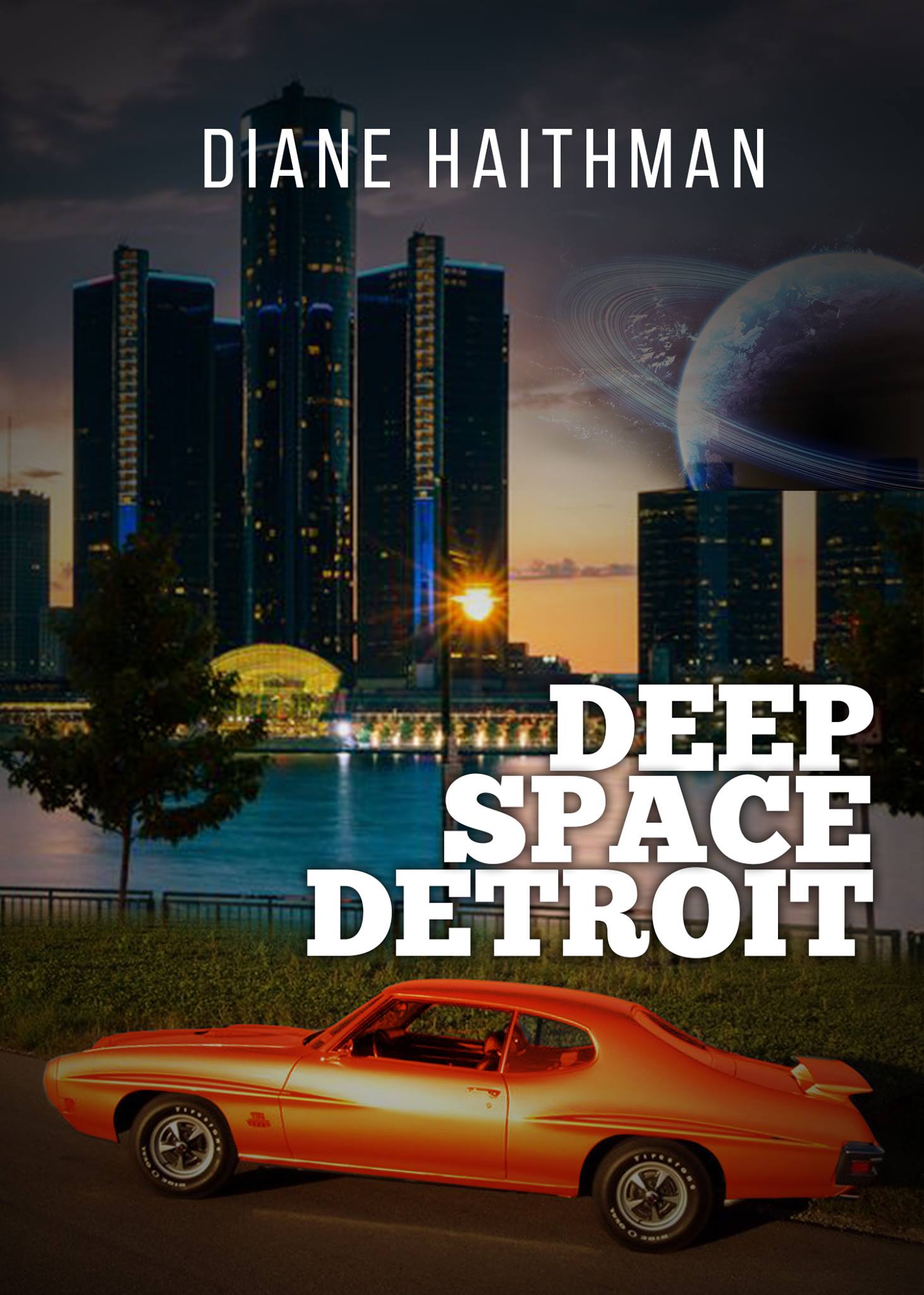
The author left Detroit in 1984 to become West Coast bureau chief of the Detroit Free Press. She moved to the Los Angeles Times in 1987 and now freelances in L.A. Her first novel, "Dark Lady of Hollywood," was published by Harvard Square Editions in 2014. This novel is unpublished.
By Diane Haithman
After pulling out of bankruptcy in 2014, Detroit is experiencing a renaissance. In fact, the Motor City has become a popular location for Hollywood producers: 2016’s Batman vs. Superman and the upcoming Transformers: the Last Knight both used Detroit locations. The Oscar-winning team of director Kathryn Bigelow and screenwriter Mark Boal (The Hurt Locker) recently announced a new film about the 1967 Detroit riots.
Things were different back in depressed 1983, when not much seemed to be going on in downtown Detroit except the closing of J.L. Hudson’s flagship department store. But what if? …
In the comedy-fantasy novel Deep Space Detroit, Mary Hammonds (white, 29) and Detroit Free Press reporter Hollis Monroe Warfield III (black, 28), find their world turned upside down when General Motors announces its plan to save the auto industry with its first space mission to the Moon Titan of the Planet Saturn.
Book excerpt
Monday, February 7, 1983
The announcement of General Motors’ first space mission called for something special: Burgers at Archibald’s Lunch.
Archibald’s Lunch was just down Monroe Street from New Hellas, Greektown’s oldest restaurant, opened in 1901. Despite its location, Archibald’s Lunch was not at all Greek, owned by a small, wiry black man who never smiled. Archibald served burgers and tuna melts only. The tuna melts weren’t any good, and Archibald usually gave anyone who ordered a tuna melt such a fearsome look the guilty party quickly called for a burger instead.
They met at Mary’s dental office, just around the corner from Greektown. “Ramona, this is Joe Ferris, pop music critic at the Free Press. Joe, meet Ramona Gold, Mary’s hygienist,” Hollis said.
“I recognized you from your picture,” bubbled Ramona, always cheered by proximity to even a minor celebrity. The balding 62-year-old Joe looked nothing like his Free Press photo, taken in 1965 (it had hair). The paper still printed the ancient picture with Joe’s concert reviews in hopes readers would not realize its Voice of Pop Music was born 30 years before rock ‘n’ roll.
Mary entered the waiting room still her white lab coat, drying her hands on a paper towel. “Joe, Mary Hammonds. Mary, Joe,” Hollis said.
“Pleased to meet you, Joe.” Mary smiled and extended her just-dried right hand. She paused. “You don’t look anything like your picture.”
“You do look a little taller.” Ramona frowned at Mary.
“Mary Hammonds—that sounds familiar,” Joe wrinkled his expansive brow. “Holy Moley, aren’t you the wife of our former movie critic, Carl Corbin?”
“Ex-wife,” Mary said quickly. “Very ex. Since last month.”
“Jeez, Carl Corbin,” said Joe, never noted for sensing the nuances of a situation before speaking. “His desk used to be right next to mine.” Joe paused. “Unusual kind of a fellow. That whole E.T. thing. What a fracas.”
“Fracas is a newspaper word, Joe,” Hollis exclaimed. “It’s like ‘brouhaha.’ We write it, but nobody actually says it.”
Freep fracas
Even as Hollis spoke, he knew he could not stop the conversation from veering toward the biggest fracas in recent Free Press history.
As it turns out, Mary was not the only one in Detroit who could never quite figure out Los Angeles transplant Carl Corbin. Neither could the readers of the Detroit Free Press, Sunday circulation 780,000, where Carl had served a brief term as movie critic after completing his master’s in film studies at the University of Michigan.

Diane Haithman
Hired by the Free Press in January 1982, Carl was abruptly let go in June of that year, right around the time of the first annual Detroit Grand Prix street race. Free Press editors mumbled something about taking the Entertainment Now section in a new direction, but it was generally understood that the new guy from L.A. had been fired for not liking E.T.
Now, Mary was no critic — but if Carl had only asked her, she might have suggested that, in a town with an unemployment rate of 17 percent, where a young Chinese-American named Vincent Chin got beaten to death outside a topless bar just because two white auto workers thought he was Japanese, in a state from which thousands of desperate former auto workers flowed like an oil leak seeking jobs in Texas or California, if you were even thinking of calling E.T. The Extraterrestrial, biggest feel-good movie of ‘82 “a maudlin, self-indulgent wallow in Steven Spielberg’s affluent childhood angst with a tired sci-fi twist,” maybe you ought to not.
Instead of arriving at the Free Press, much of the avalanche of hate mail came directly to Carl and Mary’s downtown townhouse in Lafayette Park, occasionally delivered in militant person by the writer. Carl never read the letters — instead using his newfound freedom to work on his newest screenplay: Why Here?, a story of “the relentlessly downbeat nature of young life, love and career in the chilly Motor City.” It was only a few weeks ago that Carl decided he should complete this reality-based story from a surfside apartment in Malibu.
“Well, it was a fracas…”
“Archibald’s.” Hollis interrupted Joe, gesturing toward the door. “Shall we?”
It was the first time this year Hollis or Mary had been to Archibald’s. It felt good to be back. “Hey, Archibald,” Mary called out.
“Back atcha, Dr. Mary. Long time no see.” Archibald was dapper in his white paper cap and apron. His wife Marla was in the back, placing giant plastic jars of ketchup, mustard and sweet pickle chips into a big walk-in refrigerator with a steel door heavy as a bank vault’s, apparently designed to stop condiment thieves dead in their tracks.
'Best burgers in Detroit'
Mary, Ramona, Hollis and Joe took a seat on tall stools at the white Formica counter, slick and flawless as an ice rink after the Zamboni. The four were soon presented with burgers (no tuna melts), neatly wrapped in wax paper and stuffed into cardboard boxes, alongside a handful of paper napkins and an overflow of crunchy corkscrew Whirly Fries.
“They’re just like my hair!” crowed Ramona, picking up a fry and stretching it out straight, then doing the same with one of her bright orange curls.
“I like this place,” observed Joe, wriggling to get comfortable on the backless stool. “’Course, I remember it back ‘65, when it was a sports bar named Players. See, I used to write for sports. Anything the players said or did here was off the record, else the owner, Johnny Katsufrakis, would punch the reporter smack in the nose next day. Used to have the best burgers in Detroit.” Joe saw a dark cloud pass across Archibald’s face. “Not as good as these, though,” Joe said, taking a big juicy bite to prove it.
“So, Hollis, tell me everything!” Ramona gasped, ignoring Joe’s historical lecture.
Hollis scowled. “About what?”
“You know.”
'Interplanetary luxury vehicle'
“Beats me. If you want any news on General Motors, or spaceships, or freakin’ Saturn, I’m afraid you’ll have speak with Stanley Binder.”
“Who’s Stanley Binder?”
“Hollis isn’t covering the GM space mission anymore, Ramona. His editor gave the story back to Stanley Binder, the auto reporter.” Mary gave Ramona a gentle but firm toe to the ankle with her winter boot.
“Thanks Mary, but I’m over it,” Hollis said. “My career is ruined. At least I’ll never again have to write the phrase: ‘Detroit’s first fully appointed interplanetary luxury vehicle.’ ”
“Actually, I had lunch with Stanley Binder on Friday,” Joe said, disappointed that nobody cared about Players or its excellent burgers — always top ground sirloin and served very rare — but willing to try his luck with another topic.
“How many minutes before he mentioned his Pulitzer for covering the Detroit riots in ‘67?” demanded Hollis.
“Stan’s got a Sunday mag piece coming out all about Saturn’s moon Titan.” Joe ignored Hollis. “He’s interviewing a bunch of NASA guys and researchers from the University of Michigan, even somebody out there at Caltech. That’s in Hollywood, isn’t it?”
“Pasadena. Well, what about it?” asked Hollis, curious in spite of himself.
“Well, Stanley says the Voyager I and II missions brought back pictures of Titan in 1980 and ‘81, but they didn’t have much luck getting anything on film but orange clouds. It’s like whenever I go on vacation to Colorado I try to take photos of the stars but I just end up with all these black photos. The wife hates that. But scientists think there might be some really interesting stuff under the clouds.”
“Like what?” Ramona asked.
“Well, they think the clouds indicate that Titan has air. Not like our air, different air, but still air. They think the moon might be a lot like a frozen version of planet Earth, with lakes made of gasoline instead of water.”
“We already printed that,” grumbled Hollis.
So, how cold is it?!
“Yeah, but there’s more,” Jo polished off his last three Whirly Fries. “They figure that some parts of the planet, under the clouds, might actually be warm enough for real water. Some of these science guys figure there’s a small spot, say five miles in diameter, on the surface of Titan where the weather patterns may actually mimic those of suburban Detroit.”
“Get outta here!” Hollis threw a Whirly Fry at Joe. “The temperature on Saturn is 287 degrees below zero.”
“It is like suburban Detroit,” Ramona said, just as blast of bitter cold air entered with the next customer. “Hah!”
“Detroit on Saturn’s moon Titan,” Hollis mused. “I wonder whether it has a good library and safe public schools. Or have they, like Saturn’s other frozen moons, experienced the problem of white flight?”
“Who said there was a they?” Joe shook his head. “So far, nobody has said life. All Detroit is doing is sending up a probe to gather scientific data.” He paused. “Besides, only you would wonder whether or not there are black neighborhoods on Saturn, Hollis.”
Space race, in a manner of speaking
“Well, why not?” Ramona asked. “After all, the most famous alien of all time is black.”
“Who?” asked Hollis.
“E.T.”
“E.T.?” said Hollis
“E.T.?” echoed Mary.
“Yeah, E.T. is black,” Ramona replied. “At least, I think so. Don’t you think so, Mary?”
Mary considered it for a moment. “Yeah. Sure. I guess so.” She returned her full concentration to eating fries.
“E.T. is not black,” Hollis said.
“How would you know?” Ramona asked.
“How would you know?” countered Hollis, feeling vaguely insulted, though not quite sure why.
“E.T. is a fictional character,” Joe offered gently.
“How can you tell whether a guy from another planet is black or not, Ramona?” Hollis grumbled. “That’s like trying to tell whether a reporter is black by looking at his by-line in the newspaper.”
“Hey, I can tell by looking at your by-line,” Ramona replied crisply. “Hollis Monroe Warfield III? Please. You’d have to be either a Louisiana riverboat captain, or a middle-class black guy from Detroit. Besides, I can tell E.T. is black the same way I can tell you’re black, Hollis — by looking at him. He’s the same color as you.”
“Believe it or not, that’s the first time anyone has ever pointed that out to me.” Hollis laughed. “Okay. Maybe E.T. is black. I like it. I’m sure ace movie critic Carl Corbin could have waxed eloquent on this topic.”
“Oh, let that white boy stay out there in California by his pool,” Ramona exclaimed. Ramona Gold, daughter of downtown art gallery owner Maureen McKay Gold and prominent attorney Joshua P. Gold, was always proud to have grown up in Detroit instead of the suburbs. Who wanted to live out there with all those white people, she would ask. Hollis never had the heart to remind Ramona that she was white people.
“So, what do you think, Joe?” Ramona asked. “Is E.T. black?”
“No comment. I cover pop music, not movies,” Joe said. “But Geez Louise, I certainly hope the music is better in outer space. Do you realize Duran Duran’s Hungry Like the Wolf has been at the top of the Billboard charts for three weeks? Want to know the greatest hits of the past two years? 1981: Diana Ross and Lionel Ritchie sing Endless Love. 1982: Paul McCartney and Stevie Wonder give us Ebony and Ivory. Identical plastic turds, those songs are. The music is bad, the economy is bad, the weather is bad and the cars are ugly. I tell you, I’d hate to be young in Detroit in 1983.”
“We don’t do it on purpose,” Hollis agreed.
“What do you think, Archibald?” Ramona asked, turning away from her companions.
“Excuse me, young lady?” Archibald said, shocked that the orange-haired woman with the angelic face, the one who had compared her curls to a Whirly Fry, was addressing him.
“E.T.,” Ramona said.
“E.T.?”
“Do you think E.T. is black?”
“E.T.?”
“E.T.”
“Little dude from the movie?”
“That’s right.”
“Is he black?”
“That’s what I’m asking.”
“Naw,” Archibald said, smacking two red burger patties onto the grill. “He space people.”
“Yeah, but that’s not what I want to know. I want to know whether or not you think he’s black.”
“Ramona, I’m not sure Archibald has time to talk about this,” Mary warned, watching Archibald’s sharp facial features rearrange into an even less friendly expression than usual.
'I'll tell you how bad' the economy is
There was a long pause as the burgers sizzled alarmingly. Then Archibald whirled around to face his customers. “Yes, I have time to talk about this. I most definitely have time to talk about this,” he exclaimed.
“Every day, every single day, I come in here and fry burgers,” Archibald began. “End up being about hundred burgers a day. That’s a lotta burgers, a lotta buns, a lotta them little tiny onions. Marla cuts up all them onions by hand, and I ain’t never microwaved them buns.
“I got a kid in community college at Macomb. He’s not Marla’s kid, he’s from before, but she treats him just like her kid, God bless her, even though he kind of a pain sometimes, although thank you Lord he don’t do drugs or nothin.’ And we get here at 7 a.m. because that’s when they deliver the pickles.
“You want to know how bad the economy is right now? I tell you how bad. Guy came in here other day asked me to make him a burger because he lost his house and he and his family, they been sleeping in they car. They car. And it’s a convertible.
"Anyway, I give him a whole bag. And they ain’t the only people sleeping in they cars, let me tell you. Another guy come in all happy cuz he just had a baby, this real cute little baby, except they had to have him right out there on the street on this old blanket cuz they don’t have medical or anyplace to live.
“Whole bunch of people moving out, and I ain’t blame them, but where they gonna go? Like it any better in Florida or Kansas or Texas. Still ain’t any jobs for people, a lot of ‘em end up just turning around and coming back broker than they was before. And we give away a lot but we don’t have enough burgers for everyone. We got this kid at Macomb. Marla never complains about the bills or anything even though it ain’t her kid, bless her heart.
“And then you come in here, in your nice warm coats from your nice warm jobs, probably in some kind of nice car, and sit down at my lunch counter, order you a bunch of burgers, and sit there eating my Whirly Fries, which is my very own invention and my own special recipe, and ask me whether space people black. Space people black! Nothin’ ever gonna be the same in this town again, and you want to know whether space people are black. You know what Archibald has to say about that? I say it’s a shame.”
By now, the two burgers had turned into two identical charcoal hockey pucks. Archibald flipped the ruined meat off the grill and replaced it with some fresh burgers. Hollis, Mary, Joe and Ramona stared at one another in shock.
“Sorry,” squeaked Mary, considering ordering a tuna melt just to break the tension.
“Yeah, sorry,” Hollis said, laying a Whirly Fry he was about to eat flat in the cardboard box like a body its own little coffin.
“Never mind,” Archibald grumbled. “Space people black.”
“Well . . . I gotta get back,” Mary said hesitantly. “I’ve got a 1:30. Two fillings.”
“Space people black,” muttered Archibald.
“Yeah, me too,” Hollis said. “Come on, guys.” They headed for the door of Archibald’s Lunch, Mary biting her lip and Ramona about to burst into tears.
As Joe opened the door, they heard Archibald say quietly behind then: “Say, Marla… you think E.T. is black?”
“E.T.?” replied Marla suspiciously.
“E.T.”
“Little dude from the movie? . . . ”
Learn more about the author at www.dianehaithman.com.