
A worship and study center at the West Bloomfield campus. (Facebook ph
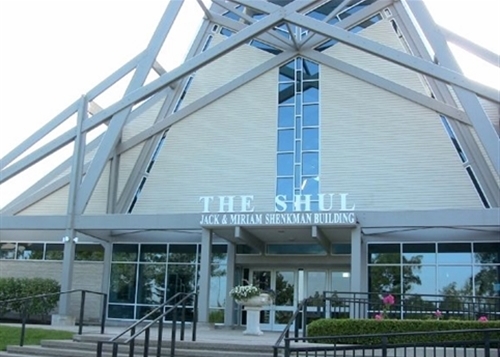
A worship and study center at the West Bloomfield campus. (Facebook photo)
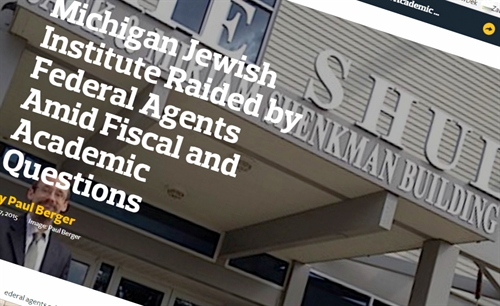
The Michigan Jewish Institute, a 22-year-old private college in West Bloomfield, is being accused of massive fraud.
In a lengthy letter to the school, the U.S. Department of Education says it received millions of federal dollars to educate students not enrolled there, David Jesse of the Detroit Free Press reports.
The government ended its eligibility for all federal funds, including student aid, the Freep reports, adding that it's unclear if criminal charges are being pursued.
The college offers bachelor degrees for careers in business and information technology, according to its website. Classes are held at the Oakland campus and online.
The federal cutoff comes eight months after agents seized 133 boxes of records on campus and at the institute's Southfield office, as Candice Williams reported last summer in The Detroit News.
The Freep writes about the new development:
In a 17-page letter to the Michigan Jewish Institute, the federal Department of Education outlines more than 2,000 cases where Pell Grant funds were sent to the school to pay for students who were in Israel studying and never took one class at MJI. A total dollar amount of fraudulent Pell Grants to the school is not known.
The institute is tied to the local chapter of the Chabad-Lubavitch, an Orthodox Jewish group with a growing campus in West Bloomfield. Rabbi Kasriel Shemtov is president of the institute and spiritual director of the Shul. The Shul is part of the Campus of Living Judaism. The school was founded in 1994.
"The evidence the department has reviewed shows that many, if not most, of MJI students had no interest in obtaining, or intention of receiving, a degree or certificate offered by MJI," a Feb. 29 letter to the school from the department obtained by the Free Press says. "Rather, they were 'enrolled' in MJI, and by MJI, for the sole purpose of getting MJI Pell Grants, while these students 'studied abroad.' Such abuse of the Pell Grant program is unacceptable."
The institute's spokesman, Steven Ellis, tells the Free Press via email:
At this time, MJI believes it would not be appropriate for it to discuss DoE’s assertions in the press or in public forums as that could be taken as politicizing the matter. "Perhaps, this is something others might do to gain some advantage, but not something MJI chooses to do while counsel and DoE are engaged.
Paul Berger of The Forward, a Jewish news site in New York, reported in 2012:
In less than a decade, MJI has transformed itself from a small campus-based college into a burgeoning online university, thanks in large part to more than $25 million in federal aid, designated for low-income students, which the not-for-profit school has received over the past five years.
But very little of this money has been spent on men and women taking courses in Michigan or, indeed, in the United States. Instead, the majority of MJI’s students can be found working toward an MJI degree in Judaic studies at yeshivas and seminaries overseas, mostly in Israel. . . .
As MJI has expanded rapidly, it has drawn increasingly on the Federal Pell Grant Program, the government’s largest education aid program targeting low-income students, which funnels public funds directly to the school. At the same time, MJI’s net income has soared. According to the institute’s most recent available tax records, between 2006 and 2010 inclusive, MJI’s net income increased to $850,000 from $89,000 — a staggering 860% five-year jump. The school ended 2010 with almost $3 million in assets. So far this calendar year, the school has received $8.7 million in federal aid.


