The Baseball Writers of America was founded by a group of sportswriters in a Detroit hotel room in 1908. They then elected the Detroit Free Press' Joe S. Jackson as the first president. The impetus for creating the BBWAA was the poor working conditions at ballparks.
The BBWAA’s founding mission was as much about serving the interests of baseball fans as the interests of baseball writers. Proper press boxes capable of accommodating out-of-town reporters meant fans in the pre-radio era could follow their teams even when they couldn’t make it out to the ballpark.
A little more than 105 years later, however, the BBWAA has become an insular and myopic “fraternity” — their word — more interested in protecting its privileges than the game or its fans.
Check your privilege
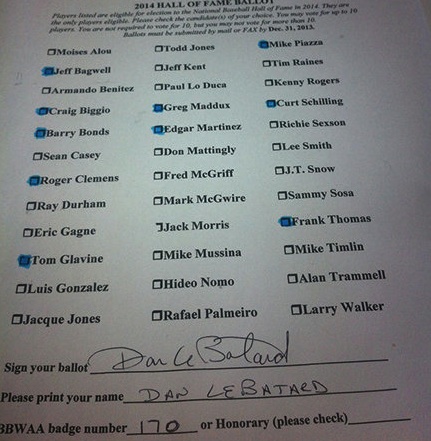
That much was evident by the BBWAA’s explanation for suspending Dan Le Betard. The Miami Herald columnist and ESPN personality effectively allowed Deadspin’s readers to cast his Hall of Fame ballot.
“The BBWAA regards Hall of Fame voting as the ultimate privilege, and any abuse of that privilege is unacceptable,” the organization said in a statement.
I’m not going to defend Le Betard or Deadspin, although I do condone their actions, because others have already sufficiently provided that defense.
What I do want to do is contrast the BBWAA’s position that the Hall of Fame vote is a “privilege” to how Detroit News’ columnist Jerry Green characterized the Hall of Fame vote in a column critical of Deadspin’s stunt.
“For all these years, I have regarded voting for the Hall of Fame as something sacred, a trust, an honor,” Green wrote last month. “It is not a frivolous duty.”
Green is correct that the Hall of Fame vote is — or should be — a sacred trust, an obligation to game, its history and its fans. It is not, as the BBWAA said, a trinket available to only a privileged, self-selected few. Even though I may disagree with Green’s opinion about Deadspin’s Hall of Fame vote, I can respect it.
What continues to bug me, however, is why so much vitriol has been directed toward Deadspin and Le Betard instead of the people truly responsible for turning the Hall of Fame vote into a farce— Green’s BBWAA colleagues.
Deadspin didn’t cast Hall of Fame votes for J.T. Snow or Jacque Jones. Talk about frivolous. If you were to present charges of Hall of Fame worthiness to a grand jury, they would indict the proverbial ham sandwich before Snow or Jones.
Deadspin didn’t cast blank ballots to protest, well, some ill-defined wrong. Induction requires 75% of the vote from all submitted ballots, so a blank vote isn’t just a protest against whatever. It is a vote against everyone on the ballot, including self-evident Hall of Famers.
Deadspin didn’t deny a vote to obvious Hall of Fame candidates because they may have played in an era when other players may have “cheated.” News flash: Every baseball player played in an era when other players cheated.
As far as the “guilty” steroid-era players — Bonds, Clemens, McGwire, Sosa, etc. — the Hall/BBWAA should either acknowledge these guys were the greatest talents of a flawed era and put them in the Hall or toss them off the writer’s ballot. Either declare every Mitchell Report player permanently ineligible for Cooperstown or create a special process (i.e. Veterans Committee/Negro Leagues selection) to determine their Hall of Fame worthiness at a later date.
The steroid purgatory is a special kind of unchecked privilege that not only affects the alleged juicers, but also borderline Hall of Fame candidates. If roughly a third of voters are perpetually filling up their ballots with Bonds and company, then it’s hard for guys like Alan Trammell, Tim Raines, or Jack Morris to receive the consideration they may deserve.
Treat the disease, not the symptom
The Hall of Fame farce is really a symptom of the BBWAA’s larger affliction. Though the organization has in recent years, to its credit, opened membership to a new breed of heterodox baseball writers and analysts, its core membership — daily beat writers — perform an increasingly obsolete task.
Game recaps were once essential for fans. It wasn’t that long ago that you’d have wait until tomorrow to read the box scores from last night’s west coast games.
Today, for all of $20, the MLB@bat app provides fans with every game’s radio broadcast and real time “gamecasts.” Box scores and stats are instantly available. For less than $200/season, fans can stream virtually every Major League television broadcast.
With the league’s official scorers, micmen, and cameras essentially plugged into our laptops and tablets, the daily beat as we’ve known it has been reduced to compiling locker room clichés about playing it one game at a time and baiting old-school managers into an occasional profanity-laced tirade.
As a journalistic guild, the BBWAA is becoming very much like the International Brotherhood of Whalebone Corset Makers.
It’s easier to report that Ian Kinsler says he’s just happy to help his new ball club than it is to effectively analyze the short-term and long-term value propositions of the Kinsler-Prince Fielder trade, I get that. However, as a reader of baseball reporting, the latter is actually interesting to me in 2014. The former hasn’t mattered, like too many beat writers, for at least 20 years.

Joe S. Jackson
Baseball writers, like all journalists, exist for their readers. They should be looking for new and innovative ways to provide the press pass-less masses with a greater understanding of the game. Instead, they are gnashing their teeth about their Hall of Fame voting privileges.
A century ago, faced with institutional impediments to bringing readers with the best possible baseball coverage, a Detroit journalist helped create the BBWAA to change things for the better. That’s a legacy all Detroit journalists should cherish.
The force of reaction to the Deadspin/Le Betard incident, and all hypocrisy inherent in that reaction, suggests the BBWAA has become the institutional impediment to modern, relevant baseball coverage.
It would be great if Detroit’s baseball writing veterans, the John Lowes, Lynn Hennings and Chris Iotts, would take up Joe S. Jackson’s legacy and craft a more modern, more relevant style of baseball coverage as well as a post-BBWAA organization to support it.
I’m not holding my breath, mind you. I just think that’s what Jackson would’ve done if he were around today.


