
Jake LaMotta
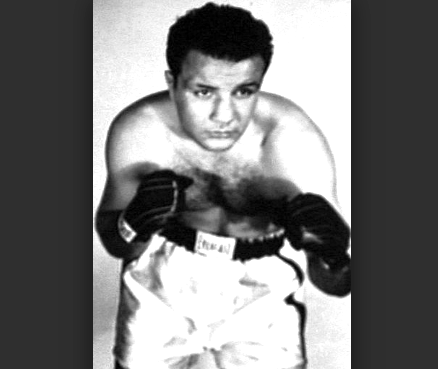
On Feb. 5, 1943, boxing history was made at Detroit's Olympia Stadium on Grand River as Jake LaMotta handed Detroit-native Sugar Ray Robinson his first defeat at Detroit's Olympia Stadium. Three weeks later, Sugar Ray would get revenge at the Olympia in a rematch.
“There's no question that [Robinson] was the greatest fighter who ever lived,” LaMotta told Jeff Wattrick, a reporter for Deadline Detroit at the time, in a telephone conversation from his home in 2013. “He was undefeated in his first 100 fights. Then I beat him!”
LaMotta, boxing’s “Raging Bull,” who brawled his way to the middleweight boxing championship in a life of unbridled fury within the ring and outside it and whose life became the subject of an acclaimed film, died Tuesday in Miami at 95.
Richard Goldstein writes in The New York Times:
A “good-for-nothing bum kid” with a terrible temper, as he later described himself, LaMotta learned to box in an upstate New York reformatory, where he had been sent for attempted burglary After going undefeated as an amateur after his release, he turned pro in 1941 and unleashed his enmity on dozens of ring opponents.
Wattrick wrote in 2013:
According to the next day’s Detroit Free Press, a record 18,930 fans packed the iconic “Old Red Barn” for the February 5th LaMotta-Robinson fight. The bout also commanded the attention of big-time gamblers.
“Oldtimers, who were regular fight patrons in the flourishing twenties, said they never saw the betting of last night equaled in Detroit,” wrote Free Press reporter Dale Stafford in the February 6 edition. “Robinson was a 2 to 1 favorite until a few hours before the fight, when a flood of Robinson money sent the price soaring.”
By the time the bell rang on February 5, 1943, Robinson was the 3 ¼ to 1 favorite. The fight went the full ten rounds and LaMotta won in a unanimous decision. Robinson controlled the bout early, but LaMotta dominated the latter part of the fight. In the eighth round, he literally knocked Robinson through the ropes.
“With Robinson sitting outside the ring, his legs across the bottom strand of ropes, Referee Sam Hennessey was about to raise his right hand for the count of 10 when the bell ended the round. The knockdown was the only one of the fight,” according to Free Press reporter Charles P. Ward’s account.
It was not only Robinson’s first professional loss, it was the first defeat of any kind in a career that had, at that point, already spanned 130 professional and amateur fights. In a pro career that lasted another 22 years and 160 more fights, Robinson would only suffer 18 more defeats. Thirteen of those would come after his second comeback in 1960 at the age of 39.
Incredibly, Robinson returned to the ring just 14 days after the loss to LaMotta, defeating “California” Jackie Wilson at Madison Square Garden. A week later, buoyed by the record gate for their previous fight, Olympia hosted a quickly-arranged LaMotta-Robinson rematch on February 26.
This time it was Robinson who took a ten-round unanimous decision. The next day, he enlisted in the army.


