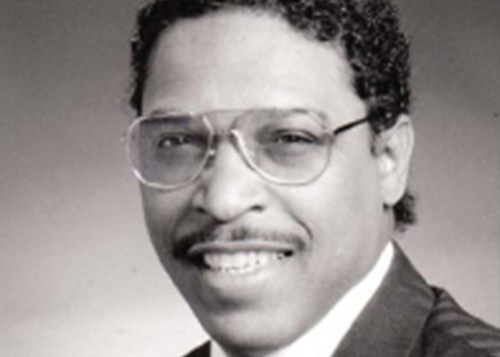
Leon Jenkins (NAACP photo)
I first met Leon Jenkins when I was covering the federal courthouse in downtown Detroit for the Detroit News.
He was a 36th District Court judge, and he was among a batch of judges that had been indicted in an FBI sting in the late 1980s. The FBI had set up cameras in a party store behind the Fox Theater in downtown Detroit, and store owner Sam Dickow, an FBI informant, was paying off judges to fix traffic tickets. It was all recorded with video cameras the FBI had planted in the store.
Jenkins was the only judge who decided to go to trial. The rest pleaded guilty. He was fighter. He was also an amusing guy. I got to know him from his days on trial.
Before I go on, for those who haven't been following this: Jenkins just made national headlines in the Donald Sterling scandal. He was heading the NAACP in LA, which gave Sterling an award in 2009 even though he was found to have discriminated against blacks and Latinos by refusing to rent apartments to them. Jenkins was about to give another big award to Sterling, who donated money to the NAACP.
Scandals have a way of finding Jenkins. Or is it vice versa?
The day he got indicted, I went out to his house in Palmer Woods to try and get a comment. He came outside and nicely asked me to leave, saying he was concerned about upsetting his children. He told me to come to his office after the weekend and he'd be glad to talk. I went there on a Monday and he was nowhere to be seen.
I saw him again at a pretrial hearing in federal court before U.S. District Judge Avern Cohn. Jenkins had attorney Cornelius Pitts, a true character right out of the movies, who was very effective in court.
When the hearing was over, the press followed Jenkins and his attorney down the hallway.
I was walking behind him, next to a friend at the Free Press, Jocelyne Zablit, who Jenkins apparently found attractive.
He turned to her and said something to the effect, about me: "I chased that guy away from my house, but you can come by anytime."
She turned to me and very discreetly said in her Lebanese accent: "Whatta pig."
The Trial
I sat through his trial and I talked to him on occasion during breaks.
About midway through the trial, prosecutors played tapes of him taking money from store owner Sam Dickow to fix tickets. Dickow played to the cameras, making sure he said aloud that this money was for that ticket, and this other money was for another ticket.
Shortly after that, during a break, Jenkins came out into the hallway and asked what I thought about the trial.
"I don't know," I told him. He pressed me again, and once again I said: "I don't know."
Finally, he insisted: "Guilty or innocent?"
"Guilty," I responded.
He said,"You'll see," and walked away.
Jenkins took the stand and testified on his own behalf. He was friendly. He didn't come off as very sophisticated, but that was to his advantage.
It made him look as if the poor guy were duped by the big, bad sophisticated FBI, even though the judge instructed the jury that it could not consider entrapment because judges knew the law and couldn't be entrapped.
Well, apparently that's what the jury must have considered. There was no other explanation. Jurors acquitted him on four of five counts. They deadlocked on the fifth count.
The people in the court gallery were stunned. Jenkins was elated. The FBI agents, who were sitting there, looked as if they had seen a ghost.
The feds prosecuted him again on the fifth count, but Jenkins once again emerged the victor.
He went on to marry a woman who worked at the courthouse. I saw an invitation that said "cash gifts appreciated." I thought it was interesting coming from a guy who chucked his career for a little extra cash.
He lost his law license in Michigan.
He eventually faded from the public eye and headed west to start anew. The California authorities yanked his law license after giving a good look at the allegations in Michigan.
I occasionally wondered what he was up to, but apparently not enough to Google him.
Then just days ago, I heard he headed up the LA NAACP and was in the thick of a scandal related to the Donald Sterling scandal.
And when he resigned Thursday amid questions, I realized Jenkins was a guy who was going to have to reinvent himself one more time.


