
“Tiger Town” first aired thirty years ago next week, October 9, 1983, and if you were a kid in Detroit in the 1980s it was a must-see movie.
The story is about as formulaic and saccharine as you’d expect from Disney family-hour fare. Billy “The Hawk” Young (played by Roy Scheider) is an aging outfielder likely never to make the post-season.
That is until he strikes up a friendship with Alex, a young boy whose father (an unemployed autoworker because everyone was an unemployed autoworker in 1983 Detroit) dies suddenly after a heartwarming father-son dinner scene.
Inspired by memories of his recently deceased father, Alex inspires the once-great, now-faded Young to lead his team on an improbable 1951 Giants-like run for the pennant.
This is pretty standard Disney shtick. Alex sneaks into the Tigers locker room to leave his hero a note: “You can do it, Billy. You just gotta believe in yourself.” Pure cornball, yeah, but even three decades later, “Tiger Town” has a certain charm.
There are obvious parallels between Billy Young and Al Kaline. Both wear the number 6 and Kaline didn’t reach the post-season until he was 33, as the fourth outfielder (behind Willie Horton, Mickey Stanley, and Jim Northrup) on the 1968 club.
“Tiger Town” is a kind of time capsule of the rust belt recession Detroit. Scrappy working-class families, rusty light posts on Michigan Ave., and gritty Tiger fans smoking in the stands. You've also got Tiger Stadium’s blue plastic seats, 20-cent issues of the Free Press, and cameos from Ray Lane, Al Ackerman, Sparky Anderson, Mary Wilson, and Ernie Harwell.
The film climaxes with our plucky hero Alex’s race to Tiger Stadium for pennant-deciding final game. He has to be at the game to will Billy Young’s late career comeback to its heroic conclusion. To get him to Michigan and Trumbull, Disney sends the poor kid on a trek through the streets of Detroit that wouldn’t even make sense to a DDOT route planner.
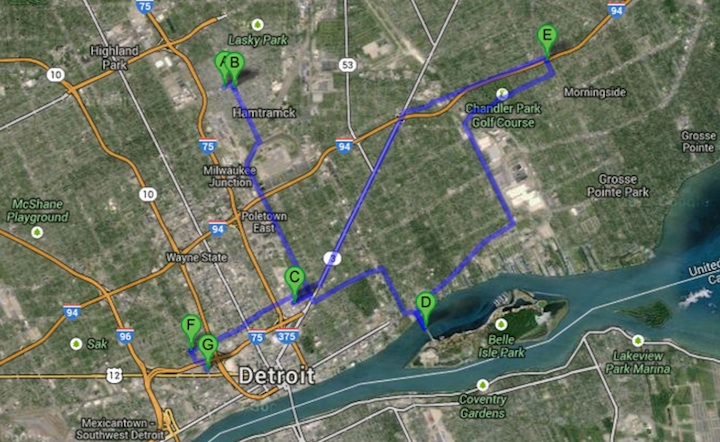
After escaping a gang of schoolyard bullies outside Dickenson West Elementary, Alex runs down Joseph Campau to catch a bus, begging for change at what was likely the Jezewski Apteka (Polish for pharmacy) at Belmont and Joseph Campau.
Missing the bus, Alex trades his belt for a girl’s bike (pink, natch) and he heads toward Eastern Market. He nearly mows down a group a ladies out shopping and almost gets killed blowing through a busy intersection because he’s that dedicated to getting to the game...via Belle Isle.
After cutting away to show the Tigers losing to arch-rival Baltimore—who really did win the 1983 World Series—Alex rides his bike across the MacArthur Bridge. The old Uniroyal plant is visible in the background.
This is where our hero’s odyssey gets a little sketchy. We see him riding his bike up large hill on a nondescript eastside(?) street. Based on a quick shot of what looks like City Airport’s parking lot, let’s assume Alex is near Outer Drive and Connor. I could be wrong about that, and it still doesn’t explain the hill, but it makes no less sense than the Belle Isle excursion.
Because bikes aren’t conducive to climbing hills, he dumps the bike and hitches a ride on the back of a bus because he lacks bus fare—50 cents—for a proper ride.
The bus takes him to the Cochrane pedestrian bridge on the (why not?) north side of I-75 as the game enters the bottom of the ninth. The Tigers are down 3-1. All told, Google Maps says Alex’s journey to the ballpark was 21.9 miles. By car, the trip would take 56 minutes. On foot, seven hours and 14 minutes. Alex’s multi-modal trek lasted less than one Major League Baseball game.
Having lost his ticket to the schoolyard toughs, Alex sneaks in through the center field gate to see his hero at the plate, representing the winning run, and facing at 0-2 count. Does he hit a walk-off homer off the light tower? No, he does not.
But he does drive the ball into deep center field and legs out (in slo mo) an inside-the-park homer to win the game, the pennant, and hearts of all Detroiters.
Even a six-year-old watching a Sunday night Disney movie on a tv with rabbits ears in 1983 could have seen that ending from a mile away. The story was maudlin, predictable, and schlocky and…aww forget it Marge, it’s Tiger Town.


