
Social media, blogs and news sites are dense-packed with tributes to Elmore Leonard, the local icon recalled as a prose purist, cool hombre and Detroit loyalist.

Elmore Leonard autographs "Freaky Deaky" for a Detroit area reader. [Photo by Alan Stamm]
Here are selected highlights for "Dutch" devotees wanting more of his voice, his wit and his legacy.
The Detroit Years: Storytelling Roots
Leonard, who died Tuesday at home in Bloomfield Township three weeks after a stroke, moved to Detroit in 1934 at age 9. He shared childhood memories with Neal Rubin in 2007:
Detroit News: Leonard's father worked for GM. He moved his family to Detroit when Elmore was in fifth grade, unpacking at the Abington Apartment Hotel at 700 Seward between Second and Third. Tommy Bridges, a Detroit Tigers pitcher, lived there, too.
It was 1 1/2 blocks to Woodward and then 1 1/2 miles north to his elementary school. Run out to the safety zone in the middle of the avenue, pick up a streetcar, and a boy could go anywhere.
"As the conductor would call out streets, I could recite them with him," Leonard says. He starts to list the intersections and finds himself stuck. It doesn't matter, but he pulls a local atlas from the credenza behind his desk and flips to a map: "Rosedale, Belmont, Trowbridge, Harmon." . . .
Eventually, the Leonards moved west, near University of Detroit Jesuit High School. He finished high school there, served as a Navy Seabee in the Western Pacific during World War II, and came home to the family apartment in a [Palmer Park] building that still abuts Woodward on Covington, north of McNichols Road.
His old neighborhoods, Detroit landmarks and the city's main north-south avenue are backdrops in many books, Rubin notes.
Not all of his novels are set in Detroit, but if there are any in Detroit that don't mention Woodward, he'd be stunned.
"You almost can't do it," he says. Woodward has the grit and the landmarks and the access.
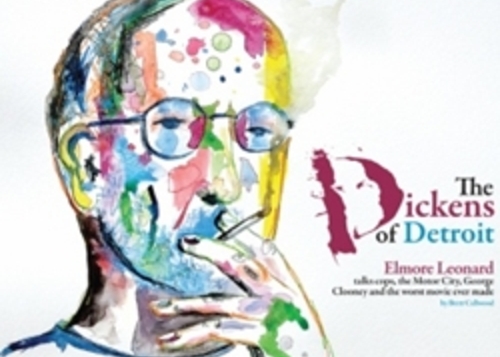
Metro Times illustration by Jaclyn Schanes in 2011.
'The Dickens of Detroit'
Time magazine tagged him with that hokey description, which Leonard scoffed at. "I was called the Dickens of Detroit simply because it was alliterative. I wouldn't have been the Dickens of Chicago," he said.
Metro Times used the phrase on a March 2011 cover story by Brett Callwood.
Cary Loren, owner of the Book Beat store in Oak Park, tells The Oakland Press he warmed to the high-flown nickname: “At first I thought, ‘What kind of cliche is that?. But in a way, Dickens really exemplified his time and his culture and what was happening at the time. Elmore does the same thing for Detroit.”
In an appreciation Tuesday at Gawker, Max Read also muses about the reference:
it's not a terrible comparison. Both men understood how important is that serious books also be funny — that humor doesn't undercut dramatic tension, but supports it and allows it to breathe. Both were masters of characterization (and of great, evocative character names). And both were great urban authors, concerned with and interested in the social relations of cities and settlements, and the movement between and among groups and classes.

Headline above explained: Vince Majestyk was a character in "The Big Bounce" (1969), which became a 1974 film starring Charles Bronson and a 2012 renamed paperback.
Raw, Real Voices
Pretty much every obituary and tribute essay mentions a universally admired Pure Leonard skill -- crisp, colorful conversations.
Here's how Louis Bayard put it in The Washington Post:
His ear for American vernacular was unmistakably his own. The many hours he spent in Detroit bars, police stations and courtrooms gave him a sense of how people reveal themselves through elision and compression.
In his bare-bones dialog, even conjunctions and punctuation drop away: “I had a tire iron we could find out in ten minutes.” “I do what she wants, she comes up with something else, I don’t talk to her.” In “La Brava,” a hoodlum tersely accounts for the money from his last heist. “I spent half of it on broads, boats and booze. The rest I just wasted.”
Asked to explain his facility with idiom, Mr. Leonard replied: “There is no secret. I listen when people are talking. I listen when they’re talking to each other, and I listen when they talk to me.”
Metro Detroiters say . . .
- Devin Scillian, WDIV anchor: I am going to miss Elmore Leonard profoundly. (That's a little joke; Dutch hated adverbs.) He meant a ton to me.
- Linda Solomon, Bloomfield Hills photographer: No one was more unaffected by success. I was always honored when he selected one of my photos for his book jackets. We were friends and when I asked him the key to success, he said "taking a risk "
- Matt Friedman, Farmington Hills PR agency partner: He could have lived anywhere and he chose to live around here.
- Susan Whitall, author and Detroit News reporter: Leonard had a particular gift for the snappy, visceral dialogue of the street and of the cop shop.
- Paul Manzella, Huntington Woods: I've read virtually everything he's written (except for some of the Westerns) and it struck me tonight that I'll have to start re-reading them, because there's no more coming. Very sad.
- Julie Hinds, Free Press reporter: His lean, vivid prose was as cropped of excess as a Detroit cop’s haircut, as authentic as the lines on a cowboy’s face. . . . And he was cool.
Funeral Is Saturday
Those who knew Leonard or his family can pay respects from 2-8 p.m. Friday at Lynch & Sons funeral home, 1368 N. Crooks Road in Clawson.
His funeral service, open to the public, is at 11 a.m. Saturday at Holy Name Church, 630 Harmon St. in Birmingham.
Memorials may be made to Maryknoll Sisters, P.O. Box 317, Maryknoll, New York 10545. Tributes and condolences can be posted here at the funeral home's site.

The Onion satire site Tuesday violated many of Leonard's widely posted "10 Rules of Good Writing."


