
(No caption)
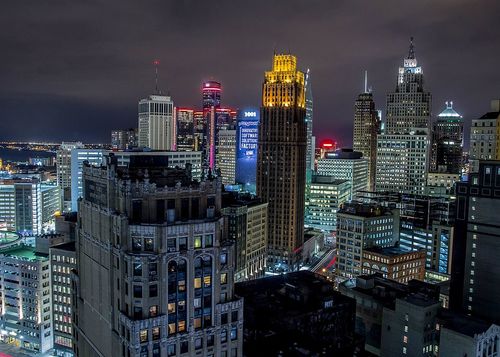
Generally, this glow isn't displacing anybody, a new report finds. (Photo: Derek Gauci, Wikimedia Commons)
Detroit is a region with no gentrification.
No, this isn't the opening of an op-ed by one of the suits at Broder & Sachse or another big development firm. It's the first sentence of a just-published academic report that measures population trends in major cities throughout the country. Rather than gentrfiying, Detroit is grappling with "staggering" levels of poverty concentration, according to the study by William Stancil, a research fellow at the University of Minnesota. And he argues failing to understand that could be detrimental to the region's future.
Poverty concentration is the phenomenon by which middle-income people abandon an area as it starts to decline, leaving it even worse-off than before. In Detroit proper, Stancil finds 86 percent of residents live in a strongly declining area.
By contrast, gentrification is when wealthy people move into an area and drive out poorer ones. That phenomenon is playing out primarily in population-dense coastal cities, Stancil's study finds. He says his methodology is more comprehensive than that of places like Realtor.com, which just yesterday named Detroit's "Rivertown" one of the nation's "fastest-gentrifying neighborhoods," and received plenty of media coverage for it. (Imagine that — an academic expert more likely to get it right than a for-profit website seeking traffic.)
But if gentrification isn't happening in Detroit, why do so many people think it is?
As luck would have it, our in-house podcast host Craig Fahle had Stancil on yesterday to discuss just that. Stancil says the confusion stems from a lack of understanding of what "gentrification" really means. Often, he says, the term is inaccurately used as a catchall to describe increasing housing costs and displacement. But there are a lot of things that can cause displacement, he says, and poverty is one of them.
"Detroit is almost certainly the furthest along in this process of anywhere in the country," writes University of Michigan research fellow William Stancil.
"Whether or not a neighborhood is economically improving or declining in both instances you tend to see housing costs increasing and sometimes it's just because average incomes in the neighborhood are declining or stagnant and not keeping up with inflation, so it seems to people that their housing costs are going up, but what’s happening is the residents are falling behind economically and people perceive that to be gentrification," he says.
Stancil adds that low-income neighborhoods, especially African-american and segregated ones — actually tend to have disproportionately higher rents compared to neighboring areas, mainly due to discrimination. Landlords know they have a captive market that has difficulty finding other housing due to issues like past evictions, and they jack up rents, causing their displacement.
Those extractive behaviors (think also of water shutoffs and tax-foreclosures), says Stancil, compound as middle-income people move out of an area and leave it poorer and more economically and racially segregated.
"What happens is there’s sort of this downward spiral that neighborhoods can take," he says. "Over policing, under policing ... slumlords, stuff like that. Services decline and so people who are middle-income living in a neighborhood like that will often leave as soon as they can and that just makes the neighborhood even poorer.
"Detroit is almost certainly the furthest along in this process of anywhere in the country."
Stancil contends that failing to recognize poverty concentration as the problem makes it impossible for people and local governments to pursue the appropriate solutions. And addressing poverty concentration, he says, is far more difficult than addressing gentrification.
"People who live in affluent areas are fine with [anti-gentrification efforts like building affordable housing and making sure existing residents don't leave] because that doesn’t interfere with their neighborhood," he says. "But when you deal with poverty concentration, a lot of the time the solution to that is to build affordable housing and put massive resources into disinvested areas. That’s expensive and it also results in a lessening of segregation and in increased racial and economic integration and people come out and protest that. If you start building low-income housing in a middle-income neighborhood, people will mob your city council meeting and say, 'don’t do that.'"
None of this to say that gentrification-esque things are not occurring in Detroit. There have certainly been cases where buildings come under new ownership, leading to the eviction of poorer tenants (Broder & Sachse's conversion of a low-income senior building comes to mind), but Stancil argues that hasn't yet happened with enough frequency to constitute a trend. His report also only covers 2000 through 2016, and doesn't take into consideration the pricing out of people who would have lived in an area had it remained affordable, like adult children who wish to stay near family in places like Southwest.
Check out the Detroit portion of Stancil's report here. His full report is available here.


