
(No caption)
Bill McGraw is a veteran Detroit journalist and co-founder of Deadline Detroit. He is creator and co-editor, with Peter Gavrilovich, of The Detroit Almanac.
By Bill McGraw
“A People’s Atlas of Detroit”
Edited by Linda Campbell, Andrew Newman, Sara Safransky and Tim Stallmann
Wayne State University Press $34.99 (40 percent off and free shipping until May 1).
Detroit’s recent wealth of expensive restaurants, $1,300 one-bedroom apartments and sidewalk scooters came simultaneously with water shutoffs, mass foreclosures and the appointment of an emergency manager who took the city into bankruptcy. Those disparities reflect what happens when corporate revitalization comes to the nation’s poorest big city.
The disproportion between haves and have-nots in Detroit spawned a significant number of activists in a multi-front battle for a more equitable city. Those individuals and groups have scored some successes, but have little access to money or publicity, unlike the developers and public officials behind the city’s “comeback.” Few of the groups are household names.
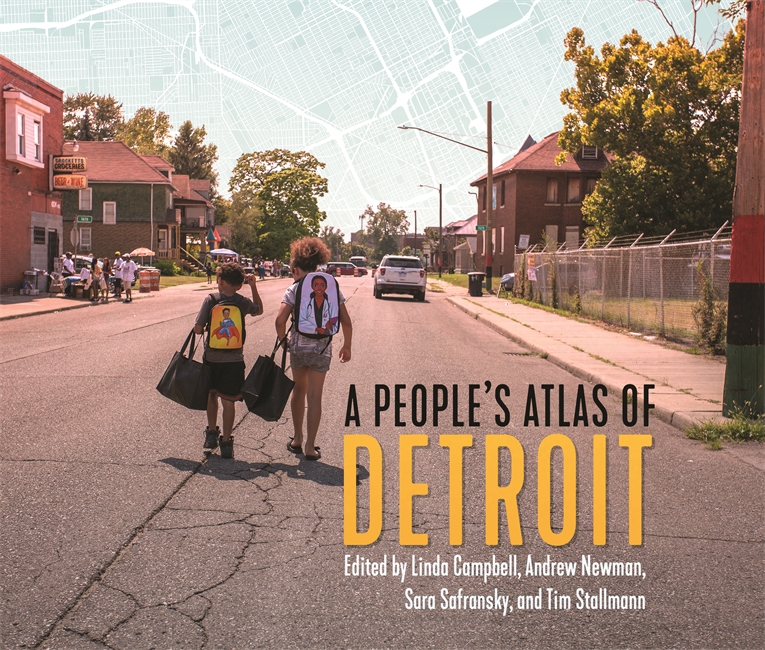
But now they have their own book. “A People’s Atlas of Detroit” is 337 pages of maps, charts, photos, essays, ideas and passion. It’s slick, smart, colorful and crammed with data, a valuable addition to the bookshelf of anyone who’s interested in Detroit politics, geography and history.
It’s an atlas with an attitude. The editors proclaim that the book’s contributors, like many Detroiters, “are contesting who benefits economically, politically and culturally from urban revitalization.” Their aim, they say, was to focus on the experiences of Detroiters “and lift up grassroots responses to racism, post-industrial decline and political abandonment.”
Even for readers who are not into urban geography, infographics or a leftist approach to solving Detroit’s challenges, the atlas is useful. It offers a detailed look at the issues that are on the front burner every day at city hall, from mass transportation to mass incarceration.
The book’s four editors include two college professors, Andrew Newman, who teaches urban anthropology at Wayne State, and Sara Safransky, a human geographer at Vanderbilt University; a Detroit activist, Linda Campbell, director of the Building Movement Project; and a cartographer from Durham, North Carolina, Tim Stallmann. They are donating all royalties to a fund to continue the work of groups they document in the book and distribute complimentary copies of the atlas to community organizations.
The profs’ influence is reflected in such academically framed concepts as “urban revanchism” (reactionary crackdowns on oppressed groups); “settler colonialism” (white newcomers replacing longtime black residents) and “racial capitalism” (white individuals and institutions using people of color to acquire social standing or economic value).
But the atlas is completely accessible, and it’s enlivened by more than 60 contributors, many of them regular Detroiters without advanced degrees. They’ve produced poems, mini-memoirs, stories, communiques, interviews and manifestos. One example: An excerpt of a letter from resident Betty A. Scruse to the management of the Alden Towers apartments on East Jefferson, protesting the “bullying tactics” used in evicting tenants after they endured years of the owners’ building neglect.
“Ironically, you hired Detroit police officers for protection when we are the victims,” Scruse wrote.
In chapter 6, “The Right to the City,” water-rights activist James W. Perkinson lays out a fervent answer to the headline, “Why I Choose to Block Water Shutoff Trucks.” He writes: “The fact that the average Detroit bill is nearly the twice the national average is not the fault of neighborhood folk who remain in the city.”
The bad guys?
The atlas also has an enemies list, and two of the most prominent targets are Detroit Future City and Hantz Woodlands.
Future City is a nonprofit think tank with heavy foundation funding that in 2013 released a complex, multi-decade plan for Detroit. Among its dozens of ideas is a suggestion that officials concentrate resources in strong neighborhoods and transform some failing districts into ecologically innovative zones of woods and wetlands. The People’s Atlas criticizes Future City for “adopting the logic of investment banking to the planning of communities.”
Hantz is run by wealthy financier John Hantz, a longtime Detroit resident whose elaborate plan for a corporate urban farm narrowed, after public pressure, into a multi-site hardwood tree farm. He’s planted more than 25,000 trees on the east side, on lots purchased from the city. The atlas contains photos by Gregg Newsom that document how a tree farm on your block can be what editors call a “surreal experience.” They also blast Hantz’s purchase of city land as a corporate land grab and example of “private management of public land in a city with struggling services.”
Reading the almanac in this extraordinary time makes you wonder what kind of city Detroit will become after the post-pandemic economic dislocation takes root. What will happen to the city budget, and already bare-bones emergency services? Will redevelopment stop? Will Detroit become a more equitable city? If those questions interest you, “A People’s Atlas of Detroit” is very worthy of your attention.


