

(No caption)
Poking at Tim Skubick is a bit like giving kick to Charlie Rose or Hal Holbrook. It may be deserved, but feels unseemly.
I watch, read and usually respect Skubick, who has been on the state government beat since he covered the 1969 swearing in of Gov. William Milliken. The weekly host of Michigan Public TV's "Off the Record," who turns 71 on May 20, is the unchallenged dean of Lansing journalism.
That longevity is impressive, until it isn't. Spending nearly half a century in a job can embarrass, if one lets it. There comes a time when shtick replaces slick, when observations sound more trite than true.
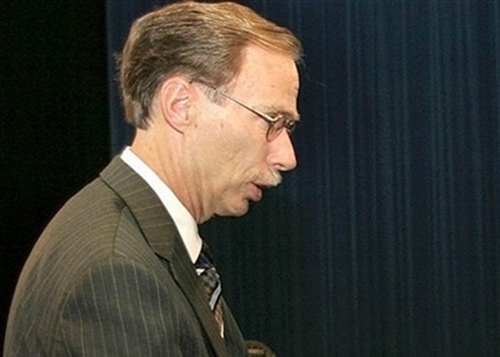
Tim Skubick: "Many of them [millennials] spend half of their lifetime posting their brains out on Facebook." (2006 photo by Bill Pugliano)
Such a time came for Andy Rooney, arguably long before he went off the air at age 92 in October 2011 (a month before he died). Many people think such a time has come for Mitch Albom, as he shows regularly to anyone who dares look.
Skubick still has plenty of game and generally isn't in that league -- when he sticks to his pool of knowledge.
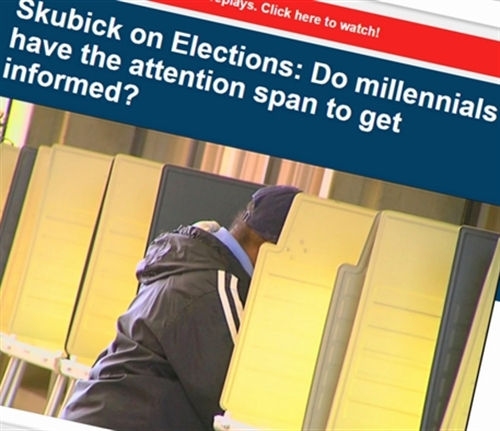
He slips beyond his depth Monday in a cringe-worthy essay at Fox 2 News, one of his multiple media outlets. Its headline -- "Do millennials have the attention span to get informed?" -- is the first sign that he's thrashing in unfamiliar waters.
That loaded question is answered by someone born 13 days after Germany surrendered in World War II -- not that any of us has an automatic shelf life. John Dingell's tweets on politics and life are smart, witty and stiletto-sharp. He's 89 and has tweeted nearly 3,800 times since joining at age 83, earning about 41,000 followers.
Switching back from the retired dean of the U.S. House to the dean of Michigan's capital media, let's examine some of Skubick's statements in a Michigan presidential primary post with just 627 words:
► "A TV station in Detroit put its pundits on Facebook [last Tuesday night] to chat about the unfolding election. There are predictions that before too long, there will more viewers via that platform than on the tube."
This may be at least part of why the old school newsman shows discomfort: His unused Facebook page has no mug shot, no cover banner, no photos at all -- just a few tagged posts and birthday greetings from 2010-15 by some of his 33 friends on that platform. (He joined Twitter three years ago this month, but hasn't tweeted.)
► "There was a chance to review the demographics of who was watching [primary night on Facebook]. There were more women than men and a good chunk of 'younger' citizens, which you might expect since many of them spend half of their lifetime posting their brains out on Facebook."
Compared to, well, a not-younger citizen who spent half this decade not posting at all on Facebook.
► "Then the young IT guy running the data reflected on the average time the Facebookies stayed with the program, which ran about 45 minutes. The reporter speculated they watched for 10 or 15 minutes and then found something else to do."
Lost me at "the reporter speculated." I prefer facts, Tim (old school that way, like you).
Perhaps those click-away viewers went to CNN or a rival local station for primary news, or to C-Span or PBS for "something else to do." If we're speculating, let's reach high.
► "Which leads to a chilling question: Is this hit-and-run generation going to seek enough information to cast an intelligent vote?"
Which leads to other questions:
- Based on the Republican fray so far, shall we also ask whether older generations are well-informed enough to cast intelligent votes?
- Is the quick-hit pundit going to seek any information about millennials born in the 1980s and 1990s beyond a hunch that "many of them spend half of their lifetime posting their brains out on Facebook?"
Leaving aside fuzzy talk of "enough information to cast an intelligent vote," let's consider this:
-
"Young voters [in the last presidential election] provided the decisive difference in Florida, Virginia, Pennsylvania and Ohio, according to an analysis by the Center for Research and Information on Civic Learning and Engagement at Tufts University. Obama won at least 61 percent of the youth vote in four of those states, and if Romney had achieved a 50-50 split, he could have flipped those states to his column, the study said. About half of all eligible people ages 18-29 voted in Tuesday’s election, roughly the same level as 2008, according to Peter Levine, the center’s director. . . .
"Increased turnout over presidential elections in 2004, 2008 and 2012 shows high voter turnout is a 'new normal' with the millennial generation, compared to less engaged voters in Generation X. In the 1990s, youth turnout was regularly less than 40 percent." -- Politico, Nov. 7, 2012 - "Daniela Enriquez, a 20-year-old student at the University of Colorado-Denver, doesn't like the way media portrays her generation in politics. 'Oh they just want free tuition,' Enriquez said, referring to how voters her age are described. 'They're on their phones all the time' or 'they're lazy.' We're highly involved, in my opinion." -- Mother Jones, March 1, 2016
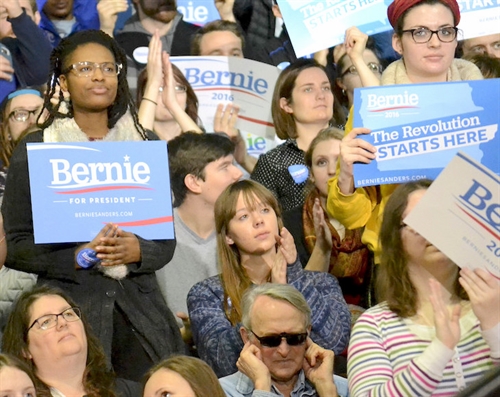
An older voter (bottom center) looks as uneasy amid young Iowa voters as Tim Skubick was while watching a newscast streamed on Facbeook.
Skubick earns good-will credit for meaning well.
Nothing is wrong with a total-immersion politics buff hoping voters are well-informed, and he steps back from the edge with a "let's be fair here" acknowledgement that his "chiliing question" also "applies to a huge batch of other voters who are much older but not a heck of a lot wiser. They are drive-by voters as well."
Fair enough, Lansing veteran -- good to still have you this election year. Just one request:
We Facebook users don't take election bets, so please drop "Facebookies."


