
(No caption)
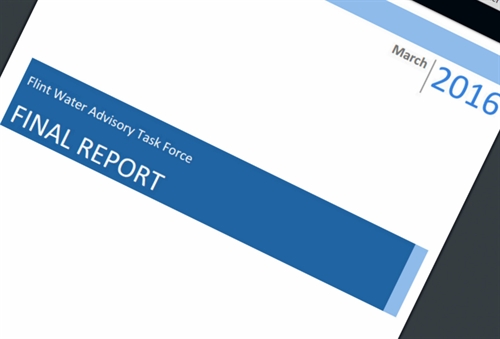
After all the congressional hearings, email releases and news reports on the Flint water debacle, a task force picked by Gov. Rick Snyder now issues a blistering report saying the catastrophe was the result of "government failure, intransigence, unpreparedness, delay, inaction and environmental injustice."

Paul Egan and Matthew Dolan of the Detroit Free Press report:
The 116-page report said the state's controversial emergency manager law contributed to the lead contamination crisis by removing governmental checks and balances. It called for a review of the law and said Snyder should look for alternatives to the current approach that keeps locally elected officials more engaged.
The report also calls for creation of a Flint Toxic Exposure Registry "to include all the children and adults residing in Flint from April 2014 to present."
Though it puts most of the blame on the state Department of Environmental Quality, the report also singles out for blame the governor's office, the Michigan Department of Health and Human Services, Flint emergency managers who Snyder appointed, the City of Flint, the Genesee County Health Department, and the U.S. Environmental Protection Agency.
Report excerpt:
"The Flint water crisis occurred when state-appointed emergency managers replaced local representative decision-making in Flint, removing the checks and balances and public accountability that come with public decision-making.
"Emergency managers made key decisions that contributed to the crisis, from the use of the Flint River to delays in reconnecting to DWSD [Detroit Water and Sewerage Department] once water quality problems were encountered.
"Given the demographics of Flint, the implications for environmental injustice cannot be ignored or dismissed."
These five men conducted the inquiry and wrote the hard-hitting task force report:
- Ken Sikkema, a senior policy fellow at Public Sector Consultants and a former Senate Republican leader
- Chris Kolb, president of the Michigan Environmental Council since 2009 and a former Democratic legislator
- Dr. Matthew Davis, a pediatrician in the U-M Health System and a University of Michigan public policy professor
- Eric Rothstein, a national water issues consultant
- Dr. Lawrence Reynolds, a Flint pediatrician and president of the Mott Children's Health Center
The summary said:
The Flint water crisis is a story of government failure, intransigence, unpreparedness, delay, inaction, and environmental injustice. The Michigan Department of Environmental Quality (MDEQ) failed in its fundamental responsibility to effectively enforce drinking water regulations. The Michigan Department of Health and Human Services (MDHHS) failed to adequately and promptly act to protect public health. Both agencies, but principally the MDEQ, stubbornly worked to discredit and dismiss others’ attempts to bring the issues of unsafe water, lead
contamination, and increased cases of Legionellosis (Legionnaires’ disease) to light.With the City of Flint under emergency management, the Flint Water Department rushed unprepared into fulltime operation of the Flint Water Treatment Plant, drawing water from a highly corrosive source without the use of corrosion control. Though MDEQ was delegated primacy (authority to enforce federal law), the United States Environmental Protection Agency (EPA) delayed enforcement of the Safe Drinking Water Act (SDWA) and Lead and Copper Rule (LCR), thereby prolonging the calamity. Neither the Governor nor the Governor’s office took steps to reverse poor decisions by MDEQ and state-appointed emergency managers until October 2015, in spite of mounting problems and suggestions to do so by senior staff members in the Governor’s office, in part because of continued reassurances from MDEQ that the water was safe.
The significant consequences of these failures for Flint will be long-lasting. They have deeply affected Flint’s public health, its economic future, and residents’ trust in government. The Flint water crisis occurred when state-appointed emergency managers replaced local representative decision-making in Flint, removing the checks and balances and public accountability that come with public decision-making. Emergency managers made key decisions that contributed to the crisis, from the use of the Flint River to delays in reconnecting to DWSD once water quality problems were encountered. Given the demographics of Flint, the implications for environmental injustice cannot be ignored or dismissed.
The Flint water crisis is also a story, however, of something that did work: the critical role played by engaged Flint citizens, by individuals both inside and outside of government who had the expertise and willingness to question and challenge government leadership, and by members of a free press who used the tools that enable investigative journalism. Without their courage and persistence, this crisis likely never would have been brought to light and mitigation efforts never begun
See the full report here.