Every Sunday, sports columnist and noted fabulist Mitch Albom steps away from covering sports to write about the More Important Things. When he does, we are here to break down his vacuous crap.
Detroit Free Press: Let’s practice saying the sentence.
“We don’t know.”
I prefer another couple sentences: Let's fearlessly seek out the truth. Let's not bury our heads in the sand of a convenient ignorance.
We will need to say it an awful lot in the coming months, because we may have our own Trayvon Martin case brewing.
We don't know what happened, but we know it'll be a Trayvon Martin-style controversy? That seems pretty presumptuous for a guy who wants us to go full Sgt. Schultz.
The shooting death of a young woman, Renisha McBride, has sides lining up. And after the shooter was charged with second-degree murder, manslaughter and felony firearm on Friday, the rumbling grew louder.
Sides lining up . . . rumblings . . . It sounds so ominous. Is a lynch mob forming to pull the shooter out of his bed and hang him from a tree? That's how Mitch makes it sounds.
That's not happening. We know that's not happening. What is happening is people believe, based on the limited evidence available to them, that the shooter did not commit an act of justifiable homicide and he should be convicted of a crime. The Wayne County Prosecutor shares that assumption, as is her duty, so there will be a trial in open court where the defendant, with the presumption of innocence, will have an opportunity to defend his actions.
Reassuring Sound, Not Ominous One
In other words, the rumblings you hear are from the wheels of justice.
But remember. We don’t know. Say it. We don’t know anything except a woman is dead and a man allegedly shot her. I write “allegedly” — even though no one apparently disputes that — because that is journalistic protocol for how you speak before a case is decided.
We would be wise to use protocol ourselves.
Actually, and far be it for me to dispute the journalistic bona fides of a man who once wrote a column about attending a basketball game he didn't attend, but what Mitch is describing as journalistic protocol is actually journalistic malpractice. To call this defendant an "alleged shooter" is to mislead the public and suggest someone else could have shot Renisha McBride.
No one disputes who shot Renisha McBride, not even the defendant. There is no reasonable or plausible alternative theory of events. What is alleged is that the shooting was murder or manslaughter. We won't know whether the shooting was or wasn't a crime until a jury of the defendant's peers renders a verdict. The proper journalistic protocol, if journalism seeks to accurately inform the public, is to say the shooter is alleged to have committed murder, but he argues it was justifiable homicide.
Because you already may have formed an opinion when you heard that a 54-year-old white man from Dearborn Heights shot a 19-year-old black woman from Detroit when she allegedly banged on his front door in the wee hours of the morning.
But we don’t know.
No, we do know that is exactly what happened.
You may feel certain there is no justification for such violence; the woman was just looking for help.
But we don’t know.
You may believe the woman said or did something threatening, because nobody just shoots someone for being on the porch, right?
But we don’t know.
Pounding a Straw Man
No reasonable person is denying that these theories are plausible explanations of why events transpired as they did. Mitch is really pummeling the straw man here. What people want is to see justice done in the wake of this tragedy. The way we get justice is for a police and prosecutors to conduct an investigation, and if they believe facts warrant it, bring charges to be considered in open court.
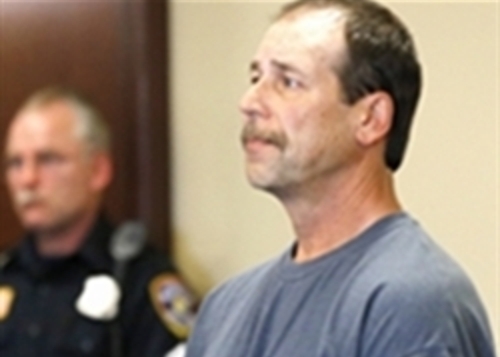
Theodore Wafer, 54, was arraigned Friday in Dearborn Heights. (AP photo/Paul Sancya)
There is no sin, no violation of due process, if everyday citizens form opinions on a case based on the evidence they know so long as the jury renders its verdict based soley on evidence presented in court -- which juries do every day and have done for hundreds of years in this country.
You may argue that people get nervous with guns in their hands, and the man, Theodore Wafer, told police his 12-gauge shotgun went off by accident.
But we don’t know.
If Theodore Wafer told police that, then we do know that Theodore Wafer told police the gun went off by accident.
You may say, as family members of McBride have told the media, that this was about racial profiling.
But we don’t know.
If the McBride family has told the media they think this case was about racial profiling, then we do know the McBride family thinks this case was about racial profiling.
You may say the way Wafer shot McBride will prove his intentions, but the family first claimed she was shot in the back of the head and the autopsy by the medical examiner’s office revealed she was shot in the face.
And we don’t know.
So we do know, or at least we can be reasonably certain, she was shot in the face. Medical examiners are capable of making such a basic conclusion without much difficulty.
You may agree with those who say, “She was just an innocent kid, her cell phone was dead, she had no options, she was trying to get home.”
But we don’t know.
Actually, we do know that insomuch as there is no evidence she was attempting to commit a crime. What we don't know is whether or not Wafer reasonably perceived her as a threat. That's what will be decided at a trial.
You may say, “She was hardly innocent, her blood-alcohol level was 0.218% and there was marijuana in her system, according to the toxicology report.”
But we don’t know.
We do know the toxicology report indicated she had alcohol in her blood.
You may think people who answer the door with a shotgun are trigger-happy to begin with, prone to shoot first and ask questions later.
But we don’t know.
You may think every American has the right to defend his or her home, that guns are constitutionally protected, that evidence will show this woman was a threat to the homeowner.
But we don’t know.
You may think, “This is an irresponsible teen. She plowed into a parked car and fled the scene of an accident because she was drunk.”
But we don’t know.
You may claim, “This is an irresponsible shooter. There were no signs of forced entry, so what harm could he have feared that justified pulling a trigger?”
But we don’t know.
You might declare, “This is what always happens. The victim will be blamed, the dead cannot speak, the shooter will be exonerated, and just like in the Martin case, the guy will go free.”
But we don’t know.
You might fret that, “Here we go again. A man trying to protect himself will be the latest pawn in the racial finger-pointing, to be vilified unfairly for the rest of his life.”
But we don’t know.
Mitch is technically correct. We don't know these things with any degree of certainty and no one is expressing these subjective as fact. People are looking at the evidence presented and making valid arguments about how and why they think events may have transpired. This is not a bad thing. Discussing cases like this, publicly exploring the variables allows us, as a citizen-lead government, to inform public policy on matters of self-defense, gun rights, and any number of other issues.
Yes, everyone should keep an open mind as new evidence emerges, but open-mindedness is not an excuse to avoid a healthy and civil discourse about the social and political issues associated with this case. Looking away solves nothing.
Emotions run hot. Conclusions run rampant. Everyone wants to solve this case before the people charged to do it get a chance. But that is not healthy. That is not wise. That is historically dangerous. Because history shows we are constantly amazed at how different a case looks once all the facts are brought to light.
Whoa now, there you go again
No one is doing that. Justice delayed is justice denied. That maxim is a long-established truth of jurisprudence. Everyone, every reasonable person, wants this case handled with all due speed. Again, there is nothing wrong with that.
I have no idea what actually happened that terrible night in Dearborn Heights. I do know that nobody wants to go through another Trayvon Martin situation, and this is a delicate tinderbox of a case, a blowing candle away from exploding.
1. You do know what happened that night, Mitch. A woman was shot. What we don't know is why.
2. If "nobody" wants another Trayvon Martin situation, then why are you writing a long column taking the world to task for rushing to judgment and such? You just invalidated the entire purpose of your column. Good work.
Everybody wants justice quickly. But justice should be immune to impatience. Justice should take as much time and effort as it needs to ensure everything and everyone is heard from and considered.
Hmmm, I wonder what our Founding Fathers said about all that? Oh, here it is: "In all criminal prosecutions, the accused shall enjoy the right to a speedy and public trial, by an impartial jury of the State and district wherein the crime shall have been committed." It's call the Sixth Amendment to the Constitution. You should read it sometime, bro.
That’s what makes justice so precious.
And that much, we all know.


