
A week from tomorrow, the basketball world converges on New Orleans for All-Star Saturday night. Now technically, the game itself the following day is the weekend’s main event, but with that contest getting less competitive each year, it’s really the league’s skill competitions that generate the most buzz.
Growing up, that Saturday night was sacred. You could have brought a team of construction workers into the house running the loudest, heaviest machinery known to man; it wouldn’t have mattered. You weren’t prying my brother Gabe and I away from the TV.
But much like the Super Bowl, we could never really take pride in our city’s representatives. Sure, the Pistons would have an occasional participant, but never did they do something heroic or walk away with one of those giant checks.
There have been 28 Slam Dunk Contests and 27 Three-Point Shootouts. Fifty-five combined winners from 21 different NBA franchises. Only a select few teams haven’t gotten their jollies on an All-Star Saturday night and the Pistons are one of ‘em. That’s not to say they haven’t had their opportunities.
Following is a list of Pistons that have heard their name called on the biggest of hoops stages, only to flop miserably, embarrassing a city and an entire fan base in the process.
ALLAN HOUSTON (1994 SLAM DUNK CONTEST)
The NBA’s showcase for slams began in 1984, but it wasn’t until a decade later that a Piston finally dipped his toe in the water. Needless to say, Allan Houston, more marksman than masher, wasn’t an ideal choice for the club’s maiden participant.
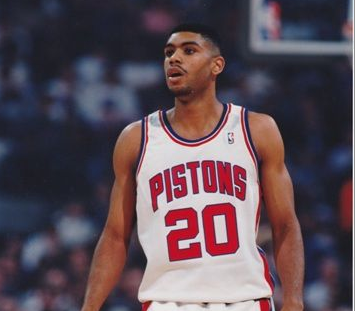
Allan Houston
In fairness to Houston, he was not supposed to be part of this. Harold Miner was the defending dunk champ, but had to pull out due to injury. Houston was a late fill-in, and in a contest where a certain amount of preparation is required beforehand, he was behind the eight ball coming in.
The TNT announcers tried to play Houston off as a worthy dunker, but it came off as more unintentionally comedic than anything else.
“Allan Houston, who played at the University of Tennessee, now with the Detroit Pistons, known more for his outside game...but remember that Allan Houston was a high jumper in high school.”
It wasn’t exactly a ringing endorsement.
Believe it or not, Houston did have a semi-decent showing. He flicked one behind his back off the glass from the free throw line and finished it with a powerful two-handed flush. He would finish fourth out of six competitors.
The highlight of the performance was his final dunk, though it is remembered more for its silliness than anything else. He approached the goal, stood for a beat, then calmly bopped the ball off his head, grabbing it on the way up and capping the sequence with a super-weak stuff through the basket. Whereas most finale dunks are met with raucous chaos and applause, this one was greeted with an unstoppable wave of laughter. Players sitting court side were doubled over -- Chris Webber almost fell out of his chair and Dikembe Mutombo cackled uncontrollably.
Keep in mind, the ball didn’t rocket off Houston’s head, causing him to leap high in the air for the retrieval and subsequent jam. The ball bumped softly off his dome, went up three or four inches, and he proceeded from there. It was at the same time the least impressive and most memorable slam dunk of the entire evening.
See the head dunk at 6:30 of this video.
TERRY MILLS (1997 THREE-POINT SHOOTOUT)
The experts say that if you’re having trouble sleeping at night, it helps to perform certain mental tasks. Counting the number of sheep leaping over a fence is popular, but they also recommend focusing on a positive memory or event from the past.

Terry Mills
When in this situation I choose the latter, and more often than not spend the next 10-15 minutes pleasantly recalling an endless slew of Grant Hill-to-Terry Mills pick-and-pops from the mid to late 90’s. That’s my safe place.
T-Mills sets a solid screen, G-Hill makes a hard move to his right, then whips the ball back to the waiting hands of the doughy, 6’10” assassin. Before you know it, the ball is in flight and I’m back in a peaceful snooze just as the pumpkin ripples through the twine. “Sugar Mills” (as George Blaha called him) cashed in 175 triples for those 96-97 Pistons, an underrated group that blended youth, experience, and a healthy dose of Doug Collins insanity on their way to a 54-win season.
The 3-Point Contest, however, was not Terry’s finest hour. In a stacked field featuring Glen Rice, Steve Kerr, and Dale Ellis, T-Mills would rack up just 11 out of a possible 30 points. He’d finish seventh out of eight, besting only Sam Perkins, who somehow managed to post a score of 8, the third-lowest total in the entire decade. (Michael Jordan scored just fivepoints in 1990, an all-time contest low).
The sad showing by Mills was not a true reflection of his ability to can the long ball. It just meant that he was a “game shooter,” a guy who excelled with something on the line and a hand in his face. There are certain things that the occasionally fitness-challenged Terry Mills was born to do; firing off 25 three-pointers inside of 60 seconds was very clearly not one of them.
JERRY STACKHOUSE (2000 SLAM DUNK CONTEST)
This was one of the most dynamic first rounds in dunk contest history. Tracy McGrady came out with a vicious, bounce-off-the-floor, reverse slam. Steve Francis followed with a thrilling one-handed finish where it looked like he’d been catapulted off a trampoline. Vince Carter trumped all of them by stepping up and delivering a 360’ tomahawk throwdown that tore the roof off the building and almost caused the contest to end right then and there. The fans were going berserk, their applause and appreciation for Carter’s effort going well beyond the standard post-dunk window.
Jerry Stackhouse
Then it was Jerry Stackhouse’s turn.
Mike Fratello joked on the telecast that it was like “coming up to bat after Babe Ruth.” The love-fest was in such high gear that Stackhouse was already approaching the basket by the time TNT cameras jumped out of the Carter interview. And Jerry’s jam was actually pretty darn good. He came in under control on the right side, did a graceful mid-air spin, and finished with a very powerful gorilla dunk.
But sometimes timing is everything, and in Stackhouse’s case, it couldn’t have been worse. The crowd offered tepid support and Stack received a modest score of 41, no surprise following Carter’s perfect 50.
His next effort was sad and symbolic at the same time. He brought out teammate Grant Hill for assistance on the attempt, two maroon-clad Pistons entering the prime of their careers. Stack set up out near half-court and came charging in. Hill bounced the ball high, then hit the deck, allowing Stack to soar over him and rattle the rim with a one-handed stuff. Only, it didn’t quite work out. The first pass attempt was errant and Stackhouse mishandled on the catch. The next pass, however, was perfect.
Stack went up high, cradled the ball in his right palm, and brought it down for a thunderous smash...off the back of the rim. The ball clanked away to the other end of the court, and Stackhouse’s hopes of advancing to the finals were dashed.
The missed slam symbolized Stack’s time as a Piston. He had the look and feel of a franchise-changing player, but there was always just a little something missing; no true “go-to” move, a jumper that went haywire too often, and an inability to take control in big games.
This would also mark Grant Hill’s last season as a Piston, and more importantly, the last time he would be a fully healthy professional basketball player. He posted MVP-type numbers that year; over the next three seasons, he’d appear in just 47 games.
If only that tag-team dunk had gone differently, the entire state of the Pistons’ future could have been altered, thus sparing thousands of loyal Detroit hoops followers the ultra-depressing predicament we find ourselves in today. Thanks a lot, fellas.
http://www.youtube.com/watch?v=XqTQ1Tl3XaY
(Hill and Stackhouse at the 1:35 mark)
CHAUNCEY BILLUPS (2004 AND 2006 THREE-POINT SHOOTOUTS)
Much like the aforementioned Terry Mills, Mr. Big Shot was much more comfortable shooting the ball in the final minutes of a close game than he was bombing away in an exhibition with no defender in sight.

Billups appeared twice in the shootout as a Piston and failed to make it past the opening round either time. In 2004, he finished in last place out of six, registering a paltry 12 points. He performed in identical fashion two years later, again managing a lonely 12 and pulling up the rear on the leaderboard.
Chauncey’s calm and relaxed release that required very little legs seemed to be the perfect fit for the 3-point format, but somehow things never clicked for him under the bright lights of All-Star Weekend. Had he been allowed to have a 6’8” forward running out at him during every shot, he likely would have made at least 90% of the shots.
He did get a slice of redemption four years later when, as a Denver Nugget, he finally posted a solid score (17) and advanced to the final round. But he went cold in the final and Paul Pierce walked away with the hardware.
Big Shot won’t be anywhere near the festivities this year, but don’t be surprised if his name pops up in the news soon. With the Pistons drowning fast in the East, there could be a host of changes on the horizon.
Deadline Detroit reader Marc Stankus suggests that one of those moves should be axing the in-over-his-head Maurice Cheeks and promoting the cerebral Billups from within. He already wears a suit and tie to most games, so it really wouldn’t be that difficult a transition. Plus, the Pistons would have a head coach with a discernible personality for the first time since Ron Rothstein roamed the sidelines. It’s a win-win for everybody.
RIP HAMILTON (2008 THREE-POINT SHOOTOUT)
Rip’s performance was without a doubt one of the most bizarre in the event’s history.
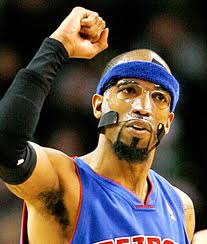
Rip Hamilton
He moved through the five racks in a fairly good rhythm, knocking down a bunch of shots and never experiencing an extended drought. With time melting away, he buried his final three attempts including the all-important “money ball.” It was good for a respectable score of 17, putting him comfortably in a tie for 2nd place.
But wait, there was a controversy brewing. Apparently the referee had caught Hamilton with his foot on the line for three of the makes, changing the 17 to a 14, thus eliminating him from the competition.
A couple of burning questions. Who can’t stay behind the line in a three-point contest? And more importantly, why is there a referee even on the court during a meaningless All-Star celebration?
The contest had been running annually since 1986 and nobody could remember another instance of a shooter being similarly penalized. It would be like a slugger swatting a dozen long balls in the home run derby, then being docked for having a foot out of the batter’s box. Things like this just don’t happen.
But when a Piston is involved on All-Star Saturday night, you are ready for such a letdown.
After the Houston noggin-dunk, the Stackhouse-Hill fumble, and a million unguarded bricks from Mills, Billups, and Hamilton, we will forever have our guard up.
In all likelihood, none of the Pistons will be invited to participate next Saturday night.
And that’s perfectly fine with me.


