
(No caption)
The third book by Metro Detroit historian and journalist Karen Dybis recounts the investigation and prosecution of a 1931 murder that sent a 48-year-old widow -- a boarding house landlady suspected as a serial killer -- and her 18-year-old son to the Michigan House of Correction in Plymouth. Chapter Four from "The Witch of Delray," going on sale Monday, is presented with permission.
By Karen Dybis
After two days of intense testimony, jurors were sent home. Saturday was a day of rest, but they were back to work on October 4, 1931, to see the scene of the alleged crime.

Rose Veres, a 48-year-old widow who spoke Hungarian, ran a rooming house where "boarders walked in, but left in pine boxes," the author writes.
Judge Thomas M. Cotter, who had agreed to [defense] attorney Frank Kenney’s request to make the trip, came along, as well. Bill Veres was in handcuffs and cuffed to a policeman; Rose Veres walked next to Kenney. Jurors were shown through the basement where witnesses said Rose, Bill and a boarder beat Mak.
Jurors also climbed the ladder from which the defense says Steve Mak fell from the attic.
On Monday, Kenney came back to court with news that neither Rose nor Bill would take the stand during the trial. He opened his defense with Detective John O. Whitman, who testified that Rose had never made any admissions concerning Mak’s death. Whitman also said Rose throughout his questioning maintained her original story that she was in an alley behind her home when Mak fell.
Detective Charles Schneider was next. Schneider explained the broken plaster, which the jurors saw in their visit to the Veres house on Saturday, was intact when he began the investigation. Kenney introduced this evidence to combat the possibility that the jury might have considered the broken plaster as evidence of a struggle.
Schneider also testified he had made a complete search of the whole attic and there were no signs of blood or struggle.
Kenney dived in deeper. "Did you see any blood stains around there?"
"No, sir, I did not," Schneider replied.
"When you made your search, did you find any blood stains anywhere in that house, basement, the first floor or the attic?"
Schneider again said, "No, I did not."

In all, Kenney brought 11 of Rose’s friends and neighbors to testify on Monday, hoping to counter the testimony of the state’s key witnesses.
There was Verona Kovalch, who lived across the street from Rose. She testified she was first at the scene when Mak struck the ground and she did not see Walker nearby. Gabriel and John, Rose's other sons, testified their brother Bill was not home when Mak fell; he was at the movies.
The defense rested.
Judge Cotter addressed the jury, giving them their charges in this case. In particular, he called attention to the hole in the ceiling at Rose's house.
"You saw the plaster. There isn’t any claim on the part of the state that the plaster you saw broken in the kitchen, and in that other room was broken at the time of the alleged killing. The police officer stated that the plaster was broken since, possibly by the men walking up around in through there or in some other way. I don't know. But, anyway, that was not the condition of the premises at the time of the alleged killing."
Judge Cotter also referred back to [prosecutor Duncan] McCrea's opening statement. "It is the theory and the claim of the state here that Mak, the deceased, was killed by these defendants and that they pre-meditated the killing, that they planned it, that there was deliberation."
Jurors retired to the jury room at 5:33 p.m. More than two hundred spectators remained in Cotter's courtroom to await the verdict. At 6:30 p.m., the jury went to dinner. Around then, counsel for both sides agreed the clerk could take the verdict in the absence of the court so Judge Cotter could come and go as needed.
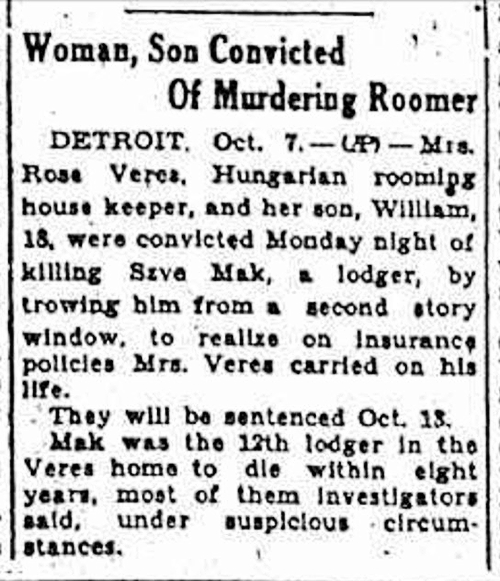
The first vote came back nine to three to convict. The second vote was eleven to one. Around 8 p.m., the jury asked to examine the window sash used as state’s evidence. Finally, on the third vote, the decision was unanimous.
Judge Cotter was not present when the jury announced at 9:22 p.m. that it was ready. The jurors were brought into the courtroom.
The jury foreman read the verdict: "We find the defendants guilty as charged of murder in the first degree."
Both mother and son now faced mandatory life sentences. Rose’s Medina Street neighbors who had stayed throughout the trial began to weep.
Rose showed no sign of emotion, maintaining what newspapers described as the same stoic expression that characterized her through the trial.
Bill, who had tears in his eyes upon hearing the verdict, wilted. He bowed his head while the jury was dismissed.

Karen Dybis also wrote histories of the Ford-Wyoming Drive-In (2014) and the Better Made snack food company (2015).
Judge Cotter, who was now back in court, told the attorneys he would sentence the mother and son in a week. . . .
Bill, visibly crushed by the jury’s decision, said only one sentence to the gathered reporters: “How could they do it?”
© 2017, The History Press
♦ Another excerpt: "Detroit's own witch trial" is at The Neighborhoods, a City of Detroit site.
♦ Buy the book: $25.76 hardback or $14.57 paperback, plus shipping, at Amazon. Or $9.99 for Kindle.
$26.73 hardback or $15.30, plus shipping, from Barnes & Noble. Or $11.49 for Nook.
♦ Meet the author: Nov. 2, 7-8:30 p.m., Caroline Kennedy Library, 24590 George St., Dearborn Heights.


