
(No caption)
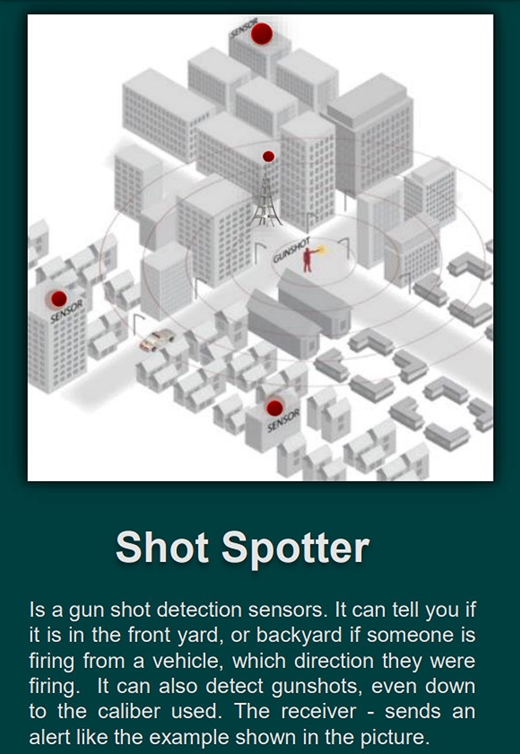
(Graphic: Detroit Police Department)
Detroit's police chief wants to use $7 million in federal Covid relief money to widen use of Shot Spotter technology in "high-crime areas," Bridge Detroit reports:
ShotSpotter, a technology that uses microphone and sound sensors to pinpoint gunfire and provide real-time data to police on where and when a gun was fired, was piloted in two of the city’s most violent police precincts last spring.
Detroit Police Chief James White said during a budget presentation to the City Council that the police department has seen a "marked decline" in violent crime in areas where ShotSpotter has been deployed and "everyone will have some coverage" in the next phase.
"There will be a strategic deployment based on the number of shots fired incidents," White told council members. "It will overlay the high-crime areas in our city." ...
Mayor Mike Duggan briefly mentioned the city's plan to use American Rescue Plan Act funds to expand ShotSpotter's use during his State of the City address, but didn't provide details. The funding is dependent on City Council approval.

Weapons seized last month in three Detroit warrant searches by 9th Precinct special operations officers. "One [warrant] was secured following a ShotSpotter notification," police post with this photo.
Critics raise concerns about effectiveness and "another form of surveillance that some regard as an invasion of privacy," posts Bryce Huffman of the news site. He quotes Police Commission member Willie Burton of District 5:
"ShotSpotter doesn’t make us safer, it doesn’t address the problems [contributing to gunfire] and no one wants to see their neighborhood mic'd up."
In a report last August, Chicago's Office of Inspector General said that city's police "responses to ShotSpotter alerts rarely produce documented evidence of a gun-related crime, [an] investigatory stop or recovery of a firearm."
Additionally, OIG identified evidence that the introduction of ShotSpotter technology in Chicago has changed the way some CPD members perceive and interact with individuals present in areas where ShotSpotter alerts are frequent.
An ACLU senior policy analyst Jay Stanley last year detailed its unease with the technology, including these issues:
ShotSpotter false alarms send police on numerous trips ... into communities for no reason and on high alert, expecting to potentially confront a dangerous situation. Given the already tragic number of shootings of Black people by police, that is a recipe for trouble. ...
The placement of sensors in some neighborhoods but not others means that the police will detect more incidents (real or false) in places where the sensors are located. That can distort gunfire statistics and create a circular statistical justification for over-policing in communities of color. ...
Communities and the police departments serving them should reject this technology, at least until these problems are addressed, including through full transparency into its operation and efficacy. ... We don't think any police technology should be deployed or used unless affected communities clearly want them.
Detroit has a $1.5-million contract with ShotSpotter Inc., based near San Francisco, that was approved in November 2020 and runs through 2023. Police began using the technology over a six-square-mile radius in parts of the 8th and 9th precincts in March 2021.


