Producer Eddie Logix and rapper Doc Waffles, known for mixing musical genres, want to start a kind of movement. Known as ‘#CoOwnaz, they hope to further spur collaboration between like-minded artists. Their album, ‘Paintings of Cats,’ released earlier this year and with a new album in process, this duo hopes to be dropping beats as long as the momentum of experimentation continues.
Tell me more about CoOwnaz.
Eddie Logix: The CoOwnaz thing is like a collective of like-minded individuals there’s not a set roster; no one holds any positions in it. It’s not an organized thing. It’s something people latch on to. It’s why we use the hashtag so even on the Internet people can be a part of it. It started out as this funny thing that had no meaning and turned into a real thing.
Doc Waffles: There are these two guys in Grand Rapids Lil Baimbeer and Doe Jumars who original came up with it and I got really excited. They’re like our boys. And we just started running with this #CoOwnaz. It’s come to describe a certain symptoms of art that we support and a spirit that we endorse. Sometimes we like to say it’s another word for ‘Friendship’. Conditions for #CoOwnaz are ideal in Detroit.
Eddie Logix: Ideal in Detroit. But not exclusive to Detroit either.
Doc Waffles: For sure. #CoOwnaz is gettin’ it in in Los Angeles right now, shout out to Tom Hanks.
Eddie Logix: Tom Hanks really supports Detroit.
How’d you find this out?
Eddie Logix: It was just meant to be I guess. There was this mutual admiration for each other, and reaching out on twitter.
Doc Waffles: Then he came to a show we had at the Ferndale Public Library last March.
Eddie Logix: We said we love "Sleepless in Seattle."
Doc Waffles: We’ve got #CoOwnaz all over the map. It’s a global movement.
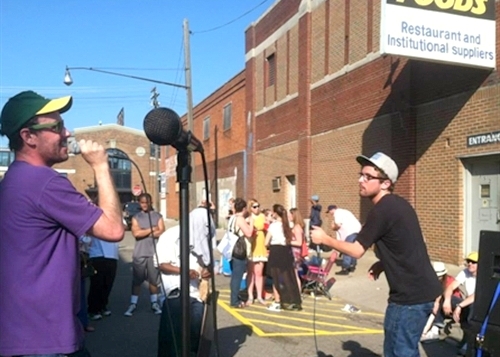
Doc Waffles (left) and Eddie Logix at Division Street Boutique near Eastern Market last spring.
Who are some people you’re excited about collaborating with?
Eddie Logix: I’m working on a project with Laura Finlay I’m really excited about that. We’re kinda working on a band thing. We’ve worked on a couple songs and we’re not sure what it will be called yet. It’s cool because it has taken me more into a moody pop music realm. I do a lot of hip-hop stuff and instrumentals, which is kinda not really bound to one specific genre. I get to work more with a vocalist and pop structures and song writing. Things that are different from the normal rap style. I can carry that into what I do with rap, like Doc Waffles. We’re working on a follow up to his last album, “Mr. What Practice Makes”. It’s a little over half-way done. We’re just rounding it out now. We also have a CoOwnaz mix tape compilation thing that has a lot of different artists on that that I’ve gotten to work with and record. It’ll be like, a lot of random rap stuff around the city with really weird concepts. It’s a dedication to our friend Mr. Meriwether a.k.a CF Hustle and we’re kind of painting this audio portrait in the form of hip-hop and rap music that describes his personality and life. I’ve also been working on some instrumental stuff with guys like Dial81, Topher Horn, Todd Moaz, Chains.
Doc Waffles: That’s part of why we came up with #CoOwnaz. It’s become so interdisciplinary. The whole Detroit scene, all the genres kind of collapse and blend with each other. So even the rap records we make now have more of a folk, songwriting approach to it. I’m doing spoken word, as much as I’m rapping and non traditional rap content.
How would you describe your style?
Doc Waffles: The raps I write can be hard to understand. The meaning can be negotiable.
They have a trippy steam-of-consciousness vibe.
Doc Waffles: That’s true. Trippy stream of consciousness is a good way to describe it. I try to embrace unconscious or automatic writing processes like The Magnetic Fields. I’m really influenced by Dada and Surrealism and their concepts and writing methods. I’m always trying to probe the unconscious because I think that’s where a lot of the appreciation of the artistic takes place. So when a phrase occurs to me that seems nonsensical but has emotional power or a deeper impact I don’t shy way from it and putting it down.
What does a producer bring to the table for local Detroit bands?
Eddie Logix: There’s a reason why artist do work with producers. Some don’t quite get that. These days there’s a do-it-yourself mentality. Sometimes it’s not about being a beatmaker. I do a lot of work and put together albums. I may not do all the beats, but I’m mixing, mastering, recording, and helping arrange the tracks and everything for an entire album for a full project.
Doc Waffles: Like I have a sound and my new record in particular is going to have a unique vibe to it and it’s suited to what I do. It’s just as much the way he produces the record and the beats.
Eddie Logix: I approach a project or an album and try to figure out how can this blend together and be one, complete thought and not just a bunch of randomness pulled out of thin air. Sometimes things can get off track. Artists on the come up might have other jobs. They can’t just go into a studio. They have bills to pay and kids and this and that. An album might take a year or more. The songwriting goes all over the place and there’s a lot that can happen to you in that time. But there are ways to figure out how to make it a complete thought and make sense.
Who are your favorite Detroit artist?
Doc Waffles: All the best musicians are from Detroit. Seriously. I listen to mostly local music. Definitely in the rap scene. There’s an overabundance of talent. James Link is a songwriter and singer that I really admire. The Jamaican Queens for sure. Good techno music. List a genre and I can go on and on.
Eddie Logix: There are so many good artists, like Doc said. From hip-hop to rock to folk to electronic. Everybody. There’s talent everywhere. And now, more than ever, everyone is coming together. You see different artists at different shows. DJs and artists at different shows. Creative energy is just bouncing all around and everyone is feeding off of it. It’s bending genres and making space for cool collaboration. Or just making it fun. It’s cool to go to a bill, where you may see an electronic DJ spinning, a rock band, and a rapper on there as well.
What are some challenges Detroit artists face?
Eddie Logix: There’s not a whole lot of fans. There’s not a lot of people who are just hanging out. You end up doing a lot of shows for other musicians, which is great, but it’s not the same as like Chicago, or New York or LA where there’s something going on every night and everyone goes out every night.
A lot of people here are already on the creative side of things. It’s like an artist community rather than a big music community where fans are coming out and checking stuff out. And paying good money to get into show or buying merchandise. Things like that. It’s harder to support yourself. It’s really easy to create and live for cheap, but it’s harder to make a living and go.
Doc Waffles: The only drawbacks are really commercial. A true artist shouldn’t be concerned with that anyway. If anything I think the conditions here are so ideal, it’s going to make it seem really bad when it goes away. It can’t last forever, and Detroit is already a changing place. It’s going to be hard to see it go. It’s not that Detroit will ever stop producing great music, it just might become more difficult. Or maybe, we can rap and sell rare books forever.
Anything big coming up?
Doc Waffles: We played a lot this summer so we’re trying to fall back a little.
Eddie Logix: We’re playing a cool show the day after Thanksgiving at the Loving Touch. Nov. 29, We’ll be playing with Lola Valley and Cold English and DJ Dante LaSalle will be there. Two great bands and a great DJ.


