

(No caption)
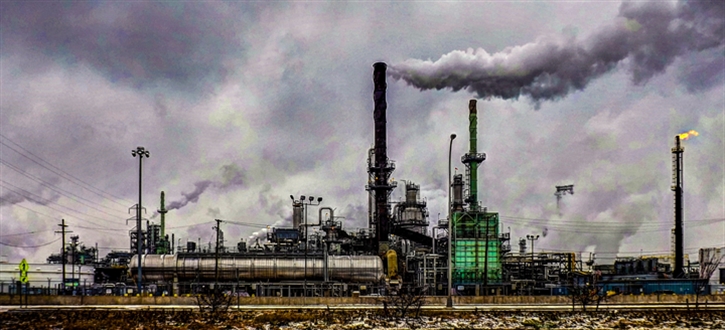
Marathon Oil 's refinery in Southwest Detroit is a prime focus of local air quality concerns and opposition to expansion plans. (Flickr photo by "DDatch54")
It's a familiar saga with a timely hook:
"Flint isn't Michigan's only disaster," says the cover story in Newsweek's April 8 issue, posted Wednesday. Senior writer Zoë Schlanger presents an in-depth look at air pollution in Southwest Detroit, Delray, River Rouge and other areas out of compliance with federal sulfur dioxide standards under the Clean Air Act.
The severe health risks affect low-income and minority residents at a disproportionately high rate, Schlanger writes in her 4,400-word article, illustrated with 10 photos by her and local freelancer Sean Proctor. There's also an interactive map of industrial polluters. The extensive research "was supported in part by the Institute for Journalism & Natural Resources," an endnote says.
"The state says it’s working on it," the newsweekly reports on efforts to cut sulfur dioxide (SO 2) releases linked to asthma.
Lynn Fiedler, of the Michigan Department of Environmental Quality (MDEQ, the same department blamed for the disaster in Flint, where lead was allowed to remain in the drinking water at levels high enough to poison children), says they’ve been “working with companies to get them to reduce their emissions,” but she stumbles when trying to explain the holdup:
“It’s been a difficult negotiation,” she says. “It involves changes in operation,” meaning polluters will likely need to install new equipment, a prospect costly enough to make them balk. . . .
Some of the biggest SO 2 emitters in the area are two postwar-era, coal-fired power plants owned by DTE Energy, located a few miles apart.
One sits in River Rouge, and in 2011 it was ranked the ninth-worst power plant in the country for health outcomes in communities of color by the NAACP. Combined, the two plants pump out 34,000 tons of sulfur dioxide each year, or the weight, in pollution, of a modestly sized cruise ship.
Getting DTE Energy to reduce emissions has been a struggle for the regulatory agency. “They are reluctant,” Fiedler says. “We are continuing discussions with them.”
In the meantime, MDEQ granted the plants a permit last year to carry on business as usual.
As I drove east from the Detroit airport into River Rouge, the acrid stench of rotten eggs filled my rental car—despite the windows being rolled up against the cold. I kept driving, and the smell acquired notes of burnt plastic and gasoline. If I had been anywhere else, I’d have worried that my car was about to burst into flames. But I was in River Rouge, so I knew better.
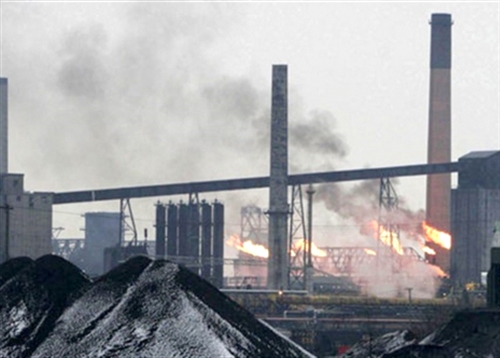
"The black, twisting infrastructure of U.S. Steel's blast furnaces gives Zug Island the feel of an industrial Mordor," Newsweek says. (CTV photo)
In addition to that type of vivid scene-setting, the writer -- who joined the magazine after graduating from New York University in 2013 with a degree in environmental studies and journalism -- shows the demographics behind complaints of environmental injustice:
According to the latest state data, more than 15 percent of Detroit’s adults have asthma, a 29 percent higher rate than the rest of Michigan. Detroiters are hospitalized for their asthma three times more frequently than other Michiganders.
Being black ups the rate significantly: Black Detroiters are hospitalized for asthma at a rate more than 150 percent that of their white neighbors—and Detroit is 83-percent black. Most of the mini-cities ringed around the heavy industry south of Detroit are majority-black too.
Poverty compounds the problem—it’s not easy managing a chronic illness when you’re making $24,000 a year, the average household income for black Detroit households. . . .
In America, race is the single biggest factor in determining whether you live near a toxic waste site. In mostly white states, it’ll be the black or Latino neighborhoods that get the oil refineries or garbage incinerators.
In and around Detroit, that’s true to an almost ridiculous degree. In 2011, Paul Mohai, a professor and the founder of the environmental justice program at the University of Michigan, mapped Detroit’s public schools over air pollution data. He found 82 percent of black students went to schools in the most polluted parts of the city, while 44 percent of white students did. What’s more, children in those pollution-exposed schools scored lower on standardized tests.
Air pollution has already been shown to cause cognitive delays in children and an array of adverse pregnancy outcomes, such as early birth and low birth weight, which can also impair a child’s brain development down the road. Of course, having severe chronic asthma and the sleep apnea that often comes with it probably doesn’t help student scores either.
Michigan tried to do something about environmental racism a few years ago: An expert panel was assembled in 2008, and it was disbanded in 2010 after issuing suggestions to the state on how to directly address the problem of poor black people being poisoned and ignored. The state set up a grievance line, but outside of that, “I’m not aware that there was any follow-up action with that plan,” says Mohai. . . .
The only positions in the Michigan Health and Human Services agency that deal at all with the intersection of pollution and health were eliminated when state budgets were gutted a few years ago. The health department has an asthma program, and the environment department has an air toxics program, but they don’t talk to each other.
And whether you’re a person of color living in Detroit or Flint, . . .you won’t get much help from the federal government: The EPA denies 95 percent of civil rights claims against polluters made by communities of color.
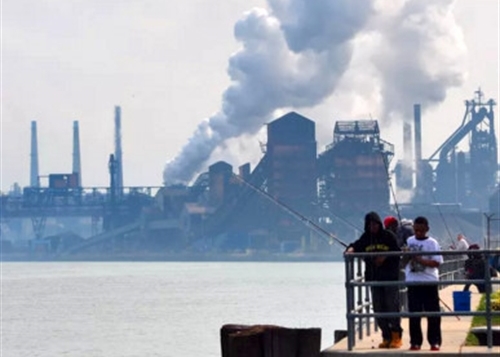
Steel foundries on Zug Island. (Flickr photo)
Against that background, Schlanger focuses on the Marathon Oil refinery in Southwest Detroit:
The MDEQ is in the final stages of granting the sprawling Marathon refinery a brand-new permit, which will let it emit an additional 22 tons of sulfur dioxide a year in an area that already exceeds federal standards for that gas.
The 22 tons of SO 2, the MDEQ insists, aren’t much. That’s true, to an extent; alone, that amount of SO 2 is not catastrophic. But the permit doesn’t take into consideration how these new air toxins will mix with all the other pollutants being dumped on the people of River Rouge. That’s because the Clean Air Act, the nation’s only omnibus air pollution bill, doesn’t have anything that considers toxic cocktails—and so puts limits on only individual toxins, and never the mix. . . .
“How can you ask to increase something like that, when people are already living here, as if it isn’t enough? When is somebody going to say, ‘No, hello, there’s people living right in the vicinity?’” asks Jacqueline Cason, who lives less than a mile from Marathon. The general sentiment is that the state is putting industry profits ahead of the people, especially black people. . . .
In an editorial [guest column] published in the Detroit Free Press earlier this year, Dr. Abdul El-Sayed, the new director of the Detroit Health Department, said: “Constricted lungs, diseased hearts, tumors in the lungs and beyond: These are consequences that the MDEQ wants Detroiters to accept,” El-Sayed wrote, lambasting the agency for moving ahead with Marathon’s SO 2 permit. “They have done so for years, and enough is enough.”
A short while after that editorial was published, Marathon began working with El-Sayed and the Detroit mayor’s office to amend their permit so it no longer includes those additional 22 tons of SO 2 per year. “We’ve heard very clearly from the residents and Dr. El-Sayed,” says Jamal Kheiry, a Marathon spokesman.
The deep-dive article concludes with this mix of hope tempered by reality:
If you’re the optimistic type, it’s possible the disaster in Flint will spark an inquest into the slow, steady poisoning of Americans of color, or at least put the spotlight on other toxic hot spots.
But the national public attention span—and the media attention fueled by it—is already waning.


