
The Rosa Parks home being reconstructed at Brown University.
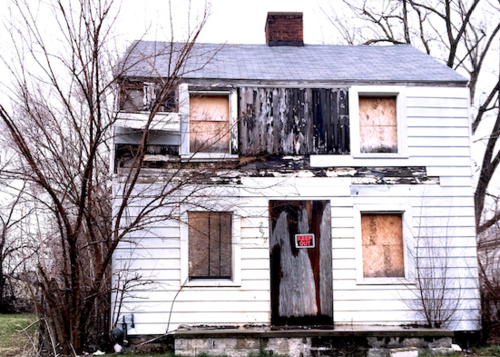
Vacant home where Rosa Parks lived (Photo by Fabia Mendoza)
In the art world, the trail of ownership on any given piece is known as provenance. In real estate, it's called chain of title. In the case of the Rosa Parks house, it's a little of both.
The house, which once stood on South Deacon Street in Southwest Detroit, is said to have been Parks' home in Detroit after she left the deep South to escape death threats over her role in sparking the Montgomery bus boycott in 1956.
It was scheduled for demolition when it was purchased for $500 by one of Parks' nieces, and artist Ryan Mendoza painstakingly dismantled it and shipped it to Berlin, where it was reassembled and stood as an art object. It has since been disassembled and sent back to the states. After an exhibit in Rhode Island, it has again been taken apart and is currently awaiting sale, in July, by an art auction house, where it could fetch a seven-figure price.
But not so fast, say the administrators of a Detroit nonprofit co-founded by Parks, the Rosa and Raymond Parks Institute for Self-Development. A lawyer for the group has sent a cease-and-desist letter, claiming Parks never lived there, despite what her surviving family says.
The New York Daily News covers the dispute:
In a book about her aunt, one of Parks’ nieces described the moment the trio showed up at the front door of the family home on South Deacon St.
“It was a great reunion, with the understanding that we would have five adults and nine children crammed into a three-bedroom, one-bathroom house,” Sheila McCauley Keys wrote in “Our Auntie Rosa,” published in 2015.
“While filled to capacity, it still provided shelter for us and a safe haven for our dear relatives. ‘There’s always room for family’ is what Father said.”
Parks told a slightly different story. In her 1992 autobiography, she wrote that her brother rented her an apartment on Euclid Ave. when she first arrived in Detroit.
“My mother and I moved in there,” she wrote in “Rosa Parks: My Story.”
Complicating matters further, other family members said Parks first settled in a different home altogether: one on Fleming St. that belonged to her first cousin Thomas Williamson.
Parks had no children, and her legacy has long been disputed by her appointed trustees, a retired judge and her former caregiver, and her nieces and nephews, who charge manipulation of their aunt as her faculties declined with age.


