

(No caption)
See if you think these dots connect well, even for our state's government: The Legislature creates an early retirement incentive . . . then pays Michigan State Police members extra to stay on the force.
Strange, but true. Evan Carter of the news site Michigan Capitol Confidential tells what's going on:
The Michigan State Police paid seven troopers more than $400,000 each to delay taking early retirement and a lifetime pension.
Another 36 officers were paid more than $300,000 each to not take advantage of an early retirement privilege.
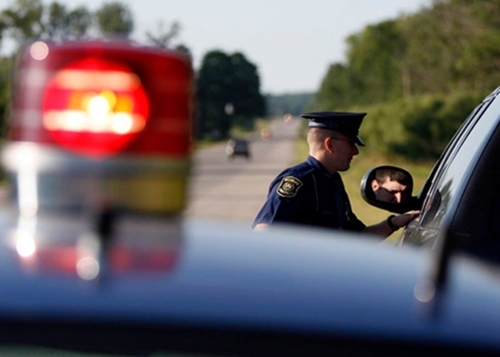
Troopers have no minimum retirement age. (Michigan State Police photo)
Carter, a reporter at the Mackinac Center for Public Policy in Midland, filed a Freedom of Information Act request. He analyzes 2012-17 records for 177 state police employees paid to stay under a Deferred Option Retirement Plan (DROP), which legislators passed unanimously in 2004.
On average, the officers were granted around $164,000 in [extra] pension benefits, while simultaneously collecting a regular paycheck.
Payment of their early pension money is deferred and delivered after they leave in one or more fat checks.
"It certainly doesn’t have a good appearance," Sen. Rick Jones, R-Grand Ledge, tells Carter. He also comments:
"If somebody retires from a position, I would prefer that they either retire or . . . continue employment with some other position."
James Hohman, director of fiscal policy at the Mackinac Center, says the DROP program adds $85 million in unfunded pension liabilities for Michigan's Treasury, based on state civil service and actuary reports.
Carter gives this context:
This legalized version of pension double-dipping . . . came about because previous legislatures had placed no minimum age on full retirement, meaning that officers could retire at a relatively young age as long as they had 25 years of service. Many do just that, going on to start a second career while also collecting monthly state pension benefits. . . .
In consequence, the number of active troopers dropped from about 1,340 in 2001 to 1,080 in 2004. But rather than addressing the source of the problem – letting state police officers stop working and collect a pension at such a young age – lawmakers instead created the DROP scheme.
The force now has 1,844 active troopers, though spokeswoman Shanon Banner tells Carter it's still a challenge to stay fully staffed:
"Because attrition has been so high and is forecasted to remain high in the upcoming years, the argument for DROP is no less valid today than it was in 2004."


