
(No caption)

A woman once interested in sports journalism alleges in a federal lawsuit that three Michigan State University basketball players raped her in an off-campus apartment in 2015 when she was an 18-year-old freshman, and the university counseling center coerced her into not reporting the incident. She also suspects she was drugged.
"MSU has fostered a culture in which female victims are discouraged from reporting sexual assaults when those assaults are perpetrated by male athletes," says a lawsuit she filed Monday.
The woman, identified as Jane Doe, is suing in U.S. District Court in Grand Rapids. The defendants are MSU and unnamed counselors at the Michigan State University Counseling Center who allegedly dissuaded her from going to police. The three players are not named.
The case is the latest accusation involving MSU and sexual abuse, and raises more questions about the school culture and how administrators handled such allegations.
The incident began the evening of April 11, 2015 when the freshman and her roommate went to Harper's Bar at 131 Albert St. in East Lansing.
After midnight, most of the MSU basketball team arrived there, including the three accused men. Earlier in the week, the team had been eliminated from the NCAA Final Four in a contest against Duke.
According to the suit, one player offered to buy the freshman a drink. She accepted. He introduced her to teammates.
"At the time, the plaintiff was a sports journalism major, so interacting with members of the basketball team was of interest to her," the federal court filing says. "At no time did plaintiff indicate she had a romantic interest in any of the team members that approached her."
Off-Campus Apartment
One player invited her to an off-campus apartment party and said roommate was going.
"At this point, plaintiff was having a hard time holding on to her glass even though she had not had a lot to drink," the lawsuit said, suggesting she may have been drugged.
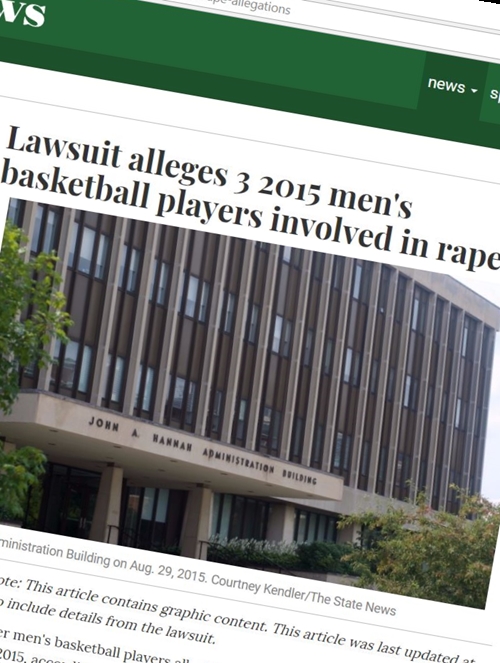
Coverage Tuesday by The State Newws student newspaper.
She accepted a car ride to the party from two players to what turned out to be one of their apartments. When she arrived, she realized there was no party and her roommate was not there.
"Plaintiff was feeling discombobulated. She tried to send a phone text, but she could not control her thumbs to formulate a text," the lawsuit says.
At that point, one of the players pulled her into a bedroom and told her "you are mine for the night," the lawsuit alleges.
The freshman was uncomfortable and was able to exit the bedroom and make her way back to the living room where she felt funny and suspected she had been drugged.
A second player offered to show her his basketball memorabilia. She agreed and asked for some water because she was incredibly thirsty.
She was given water and the second player took her into the bedroom, where he forcibly threw her face down on the bed and raped her from behind, the lawsuit alleges. She was "was crying, she could not move, nor could she speak. At no time did she consent to the sexual activity," the suit said.
After that, the two other players came into the room and held her down and took turns raping her, the lawsuits says.
Several days later, on April 20, a friend took her to the MSU Counseling Center where she reported the rape to a counselor and completed an initial intake and assessment.
Warned of Difficult Process
But when she told the counselor that the three attackers were notable MSU basketball players, the counselor suddenly announced she needed another person in the room. So another counseling center staff member entered.
The MSU counseling staff told her she could file a police report or deal with the aftermath of the rape on her own.
The staff, the lawsuit said, "made it clear to plaintiff that if she chose to notify the police, she faced an uphill battle that would create anxiety and unwanted media attention and publicity as had happened with many other female students who were sexually assaulted by well-known athletes".
They said, in effect, “we have had many other students in the same situation who have reported, and it has been very traumatic for them.”.
The staff went on to say that they had seen a lot of these cases with “guys with big names” and the best thing to do is to “just get yourself better."
The freshman took that to mean the staff was implying it would be best not to go to police, and was told "if you pursue this, you are going to be swimming with some really big fish," the lawsuit said.
The freshman was "so discouraged by the representations made by the (counseling staff) she became frightened to the point that she decided she could not report the rape(s) to law enforcement."
Additionally, the counseling staff did not tell her of her option to report the rapes to the Office of Institutional Equity (OIE) nor did they notify her of her Title IX rights, protections and accommodations, the suit says.

Photo by Derrick L. Turner of MSU Communications and Brand Strategy office.
She "lived in fear every day that she would see her attackers," the suit says.
Several months later, in October 2015, she became so traumatized, depressed, and withdrawn to the point that she was admitted to the Sparrow Hospital outpatient psychiatric day- program for intensive psychiatric treatment, the suit says.
Left College
In fall 2015, she stopped going to class.
She received a tuition refund after explaining to university officials that she had been raped and was suffering emotional, mental, and physical trauma, the suit says. The university provided no guidance beyond that.
She returned to class in January 2016, and changed her major and goal of becoming a sports journalist.
"The repeated comments made by the staff at the MSUCC suggest that female students are discouraged from reporting sexual assault when the alleged perpetrators are well-known athletes,"the suit says.
"Discouraging female students from reporting sexual assaults committed by student athletes plausibly creates an environment where football and basketball players can sexually assault females without repercussion."
The suit asks for an unspecified amount of money for damages and demands that MSU take steps to investigate and "prevent sex-based discrimination and harassment, including sexual assault, in all its programs and activities. "
"Plaintiff has suffered emotional distress, psychological damages, physical manifestation of psychological distress, humiliation, loss of self-esteem, loss of enjoyment of life, loss of earnings, loss of earning capacity, and past and ongoing medical expenses as a direct and proximate result of Defendant's deliberate indifference to her rights," the suit states.


